The Enlightenment was a period of intellectual, scientific, and cultural flourishing, roughly situated between the seventeenth and eighteenth century and culminating with the French Revolution in 1789. Characterized by a marked belief in progress and a staunch defence of the powers of reason over superstition, it witnessed the spectacular emergence of individual autonomy and social equality, namely through its virulent critique of ecclesiastical and royal authority. It represents nothing less than Europe’s access to modernity, and alongside Scotland and Germany, France was particularly instrumental in sparking this movement.
Despite his not enjoying the notoriety of some of his contemporaries, Pierre Bayle’s contribution to Enlightenment thinking remains central. Converting to Catholicism after his sojourn at Toulouse with the Jesuits, Bayle (1647–1706) returned to his Calvinist faith in 1670. After Protestant universities closed in France in 1681, he moved to Rotterdam (Netherlands), where he wrote and published his Dictionnaire. Mullock obtained a copy of this volume, with his superiors’ permission, between 1825 and 1830, and so before his ordination. It was originally published in two volumes, though later augmented to three, which is the edition in the collection. Bayle’s magnum opus contains some of the most rationalistic positions circulating during the Enlightenment, to the extent it became a reference work for deists and atheists in the eighteenth century. Dictionaries are specifically modern works, replacing the hierarchized vision of the world typical of medieval society with the systematic attempt to classify knowledge, namely by listing alphabetically the main figures of philosophy. Bayle’s Dictionnaire is the second in its genre, meant to correct the mistakes and supplement Louis Moréri’s Grand Dictionnaire historique (1674). However, it distinguishes itself by its clear efforts to separate religion from morality, claiming that moral duties are universal and framed by the exercise of reason rather than guided by tradition or revelation. In the aftermath of the devastating French Wars of Religion (1562–98), the Dictionnaire proposes a message of tolerance and open-mindedness, reminding its readers that pagans could be as virtuous as Christians could be corrupt.
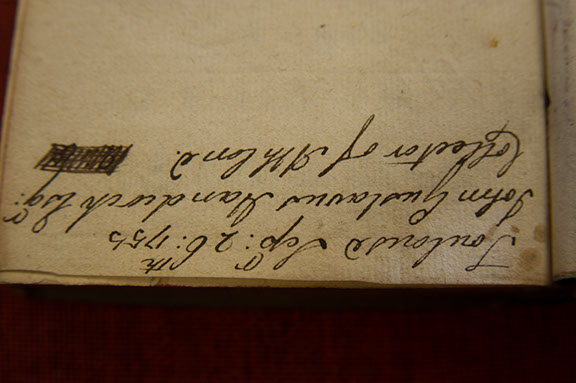
Montesquieu's Lettres persanes, vol. 1
Armorial bookplate on front pastedown and inscription on front flyleaf of John Gustavus Handcock, collector of Athlone in Montesquieu's Lettres persanes, vol. 1 (Cologne: Pierre Marteau, 1754).
Courtesy of the Basilica Museum - Mullock Library, St. John's, NL.
More caustic is Montesquieu’s (1689–1755) epistolary novel, Lettres persanes, published anonymously in 1721. Scathing and mordant, it caricatures to the point of ridicule the absolutism of Louis XIV (by that time deceased), the Régence (i.e., the period between Louis XIV’s death and the majority of Louis XV), and Catholicism in general. A renowned magistrate and trained in law, Montesquieu also explores the nature of power, laying the groundwork for his masterpiece, De l’Esprit des lois (The spirit of the laws). In doing so, Lettres persanes often appears to engage with the Leviathan (1651), Thomas Hobbes’s seminal work on statecraft. Against the latter’s thesis of a basic antagonism between individuals as constitutive of civil society, Montesquieu defends humanity’s natural sociability and warns against the English philosopher’s absolutism. It is quite remarkable that this book, most likely purchased in Ireland in the 1830s after Mullock’s ordination, should find itself in the hands of a nineteenth-century Roman Catholic bishop, let alone be made available to the seminarians at St. Bonaventure’s College.
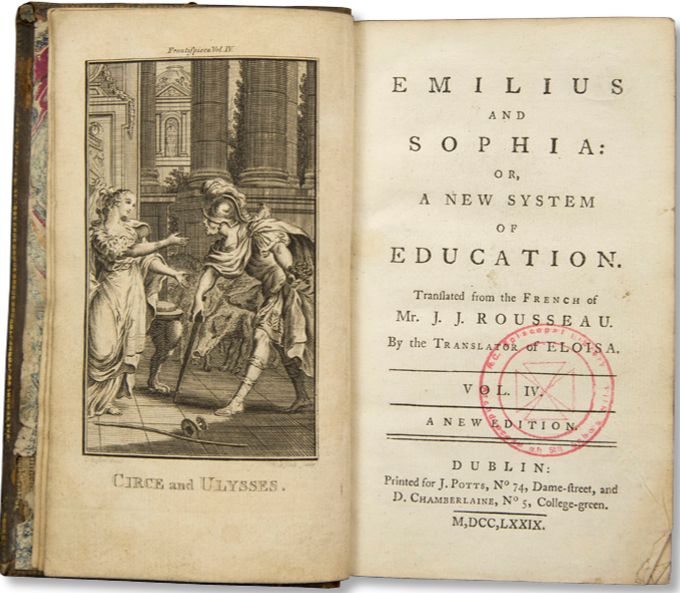
Rousseau's Emilius and Sophia: or, A New System of Education, vol. 4
Title page and frontispiece of Jean-Jacques Rousseau's Emilius and Sophia: or, A New System of Education, vol. 4 (Dublin: J. Potts and D. Chamberlaine, 1779).
Courtesy of the Basilica Museum - Mullock Library, St. John's, NL.
Just as notable in the Mullock collection is an English translation of Jean-Jacques Rousseau’s groundbreaking volume on education, Emilius and Sophia. Yet again, here is an author who nurtures deep reservations—if not downright hostility—toward Catholicism. It would not be an overstatement to see in Rousseau one of the central pillars of the Enlightenment. In addition to his contributions on politics, ethics, pedagogy, and aesthetics, he also collaborated with Denis Diderot and Condillac on the Encyclopédie, successor of the aforementioned Bayle’s Dictionnaire and often considered the defining work of the French Enlightenment. Emilius and Sophia, published in 1762, along with Rousseau’s other major work, Du contrat social, unleashed a violent reaction from crown and church, the latter immediately placing the two books on the Index of Prohibited Books. Emilius is a pedagogical treatise investigating the duties specific to human beings. It makes the case for an unmediated process of learning whereby the tutor does not teach anything per se but acts as an observer who sets the stage for the student to discover the world by himself or herself. It can be placed within the context of a modernity that begins to take notice of the distinct reality of childhood. As such, it examines the perilous passage from innocence to maturity, looking to provide the child with the necessary tools to develop his or her freedom and reason to his or her full potentiality. With its implicit attack on previous pedagogical models that merely asked the student to reproduce existing orders and instead emphasizing innovation, Emilius and Sophia is progressive in its outlook. Mullock purchased this volume after his ordination in 1830, and, with his King James Bible, it is the only other book in his collection to have received papal permission.