John Tillotson: The Works of the Most Reverend Dr. John Tillotson
Feild’s ownership of John Tillotson’s The Works of the Most Reverend Dr. John Tillotson (London: Benjamin Tooke, John Pemberton and Edward Valentine, 1722) emphasizes the bishop’s belief that it was crucial to protect the Church of England’s history as its source of authority. Tillotson, tutor to the son of Oliver Cromwell’s Attorney General, Edmund Prideaux (Spellman 1), was later appointed as the nonjuring archbishop of Canterbury who was best known for advocating that Christians should approach their faith from a rational perspective. Tillotson’s view earned him the ire of certain groups, who labeled him a “latitudarian” or someone who did not give special treatment to any specific creed. Critics argued that Tillotson’s desire for a minimal creed removed emotion from scriptural practice and reduced transcendence of the mysteries of faith to self-serving calculations. Other factions respected him as a Restoration divine. Those who praised Tillotson argued that he “considered it to be an essential Christian Duty for each individual to examine the rational grounds for their faith, and this conviction was rooted in his belief that the Christian faith reinforced the Natural Law” (Spellman 2).
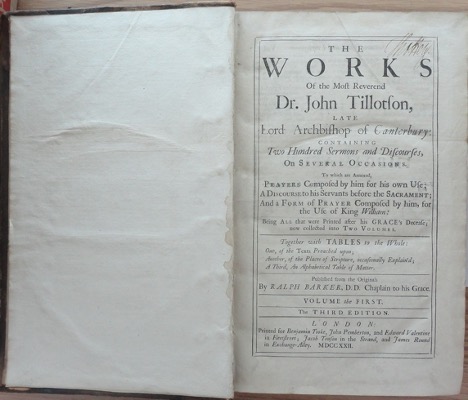
Tillotson disseminated his teachings through 250 sermons and other writings, which remained popular into the nineteenth century. Tillotson claimed that it was necessary for people to understand the logic of belief in order to worship God. He discussed the controversy of the Rule of Faith or the authority of the creeds in the preface to his collected works. Tillotson argued that John Sergeant (1623-1707), a Roman Catholic controversialist and author of Faith Vindicated from the Possibility of Falsehood, wrongly attributed mathematical rules to the practice of spirituality (Southgate 1). According to Tillotson, the “Being of God is not mathematically demonstrable” (iii), as an omnipotent entity cannot be understood through corporeal means. Tillotson’s main problem with his opponent’s argument was that Sergeant assumed that humans, wholly fallible in their views, could prove the existence of a perfect being, thus casting doubt on the integrity and authority of the Scriptures. Although Tillotson acknowledged that the Scriptures may have been written by humans, he was “assur’d that it is not, nor hath any prudent man any just cause of to make the least doubt of it” that God “dictated” these texts to the apostles because of their inherent wisdom (iii). As such, Tillotson relied on the common argument that the sacred Scriptures are always valid, although people continually misinterpret their message.
Tillotson’s works are relatable to Feild’s Tractarian beliefs in that both adhere to a strict protocol of protecting and following the Scriptures in traditional ways. Namely, Tillotson and the Oxford Movement argued that the Church of England’s teachings should not be questioned because of their divine nature. To these devout individuals the Scriptures are unchangeable and infallible. Proper instruction was necessary to teach people how to properly interpret scriptures and to prevent any further misinterpretation. As such, Tillotson and subsequently Feild contend that a proper method of worship is needed to uphold the Church of England’s sanctity.