Spanish and Italian Drama
The collection of dramatic works in the Mullock collection is varied and sizeable enough to be quite noteworthy. In addition to the works of two classical Latin dramatists, Terence (Leiden, 1626) and Seneca (Paris, 1563), the collection includes theatre from the sixteenth to the eighteenth century and in all of the languages in which Mullock was fluent: Italian, French, Spanish, and English. Terence, who was born in Carthage, North Africa, in 195 BCE was brought to Rome as a slave but was later freed as a result of his intellectual qualities. He became a celebrated comic dramatist in his day and his plays had a profound influence on both medieval and Renaissance literary culture, owing to the quality of his language, which was considered a pure form of Latin. The religious in monasteries and convents learned Latin by copying, memorizing, and performing Terence’s plays. Even today, the impact of Terence is lasting. Many well-known proverbs, such as “Moderation in all things” and “Where there’s life, there’s hope,” come from his plays. Terence had an important influence on later dramatic writers, including the French dramatist Molière.
If Terence is one of the greatest comic Latin dramatists (after Plautus), Seneca is the greatest Roman tragedian. Seneca, born in 4BCE was raised in Rome, where he was tutor and later advisor to the emperor Nero. The Mullock collection contains a 1563 edition of Seneca’s tragedies, printed in Paris. It contains all ten tragedies attributed to Seneca (two of which have now been repudiated), including Oedipus and Medea, two of his better-known works. Seneca was crucial in the development of tragic drama in sixteenth- and seventeenth-century Europe, particularly in France and England, influencing playwrights such as William Shakespeare and Jean Racine, as well as Catholic and Protestant playwrights of the sixteenth century who adapted biblical stories for the stage.
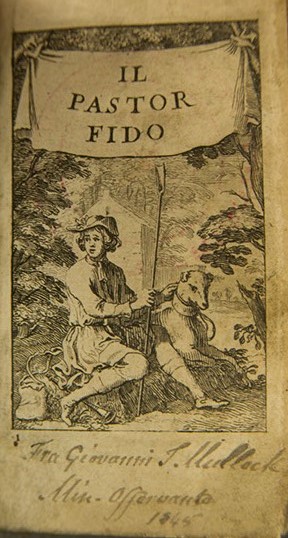
Mullock’s evidently strong interest in theatre is further shown in his book collection by a lovely pocket-sized edition of Il pastor fido (The faithful shepherd), printed in Amsterdam in 1678. Il pastor fido is a pastoral tragicomedy by Giovanni Battista Guarini (1538–1612), first published in Venice in 1590. Guarini was a poet and professor of literature and Il pastor fido is his best-known work and also one of the most popular plays in the seventeenth century. The story of two pairs of star-crossed lovers in mythical Arcadia, it inspired the 1712 opera of the same name by George Frideric Handel.
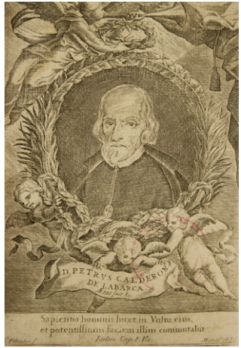
The Golden Age of Spanish drama is represented in the Mullock collection by a 1687 edition of Pedro Calderón de la Barca’s comedies. This volume bears an inscription by Mullock, “Dublin, 1846,” indicating that he purchased this volume while he was guardian of Adam and Eve’s. Calderón (1600–1681) is known as one of Spain’s foremost dramatists, and quite a prolific one.
He began writing plays at a very young age and most of his early plays were secular in nature and are appreciated for their complex dramatic structure. Calderón spent most of his life as a court dramatist and his plays are synonymous with the court theatre of seventeenth-century Spain. Even when he became a priest in later life and turned toward religious themes in his plays, he remained in the inner circle of King Philip IV, and upon the king’s request, wrote a total of almost 80 autos sacramentales, morality plays in the medieval tradition. These autos were meant to be performed outdoors to celebrate the mysteries of the Eucharist on Corpus Christi day.