Johannes Sleidanus: A History of the Church of England
Feild’s desire to study England’s past is manifested in his collection of books that focused on the Church of England’s development from the Reformation onward. In particular, Feild owned a copy of Johannes Sleidanus’s Historie de la Reformation (Ala Haye, Frederic Staatman, 1767), and its England translation, The General History of the Reformation of the Church, From the Errors and Corruptions of the Church of Rome: By Martin Luther (London: Abel Small and Henry Bonwicke, 1689), edited and translated by Edmund Bohun. Johannes Sleidanus (1506-1556), also known as John Sleidan, was a German historian who focused on the history of the Reformation. Sleidanus initially lived in Schleiden, Germany, and later attended university in Paris (1524 to 1533), where he worked under Cardinal Jean du Bellay (1492-1560) as an apprentice in close association with Francis I’s court (Vogelstein 1). Sleidanus returned to Strasbourg in Germany in 1545, when an anti-Lutheran movement gripped France (Bohun i). While there, he acted as the city’s liaison with other German principalities.
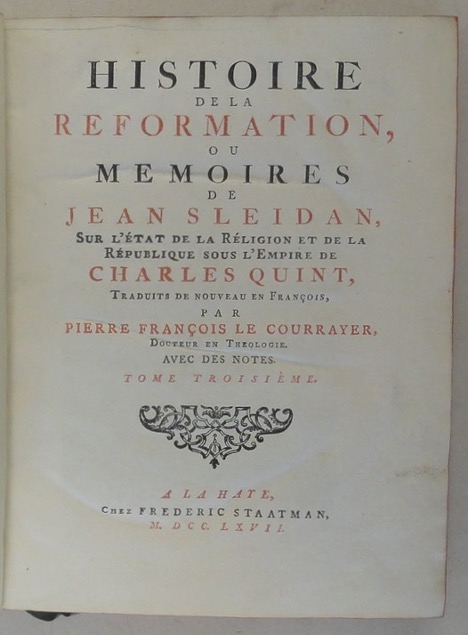
Sleidanus’s wide-ranging diplomatic experiences gave him insight into the political ramifications of the Reformation, which he recorded in the Latin version of The History of the Reformation of the Church. His work became widely popular both in England and Germany, later earning an English and French translation. Sleidanus favoured Protestantism’s rise against Roman Catholicism and shared a sympathetic view of England’s struggles for religious independence from Rome. Roman Catholics were angered by his writings and the Vatican condemned his book as seditious propaganda against the pope; it was also rejected by German princes, who sided with Rome.
Sleidanus’s The History of the Reformation of the Church supported the supremacy of the English church and the significance of the English Reformation for the history of Christianity. Sleidanus used archival and diocesan records, in combination with his own experiences, to describe the events that led up to the Reformation and the aftermath of this religious upheaval. The main purpose of his history, he stated, was to document how “God has ever used to raise up Illustrious and great Princes, when the Ecclesiastical or Civil state were to be changed” (i-ii). Sleidanus connected the Reformation with Charles V’s reign to demonstrate his conviction that the German emperor was predestined by God to be a great ruler during a period of religious and political strife. Sleidanus’s work echoed contemporary arguments on the divine right of rulers, which was later enthusiastically embraced by political leaders, namely the German princes.
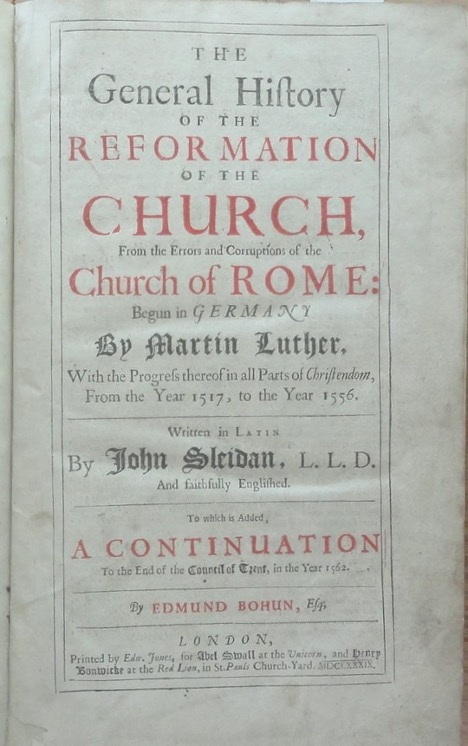
Why Feild owned a copy of Sleidanus’s work is best exemplified by Edmund Bohun’s own words. A political theorist and Tory propagandist, Bohun (1645-1699) edited his own version of this essential Reformation history and maintained that Sleidanus’s writings were important because they documented when “[o]ur Church was in the Lowest degree of danger, out of a belief that it might contribute something to her preservation, in that storm which lay so heavy upon her” (i). Bohun, and subsequently Feild, believed that Sleidanus captured the Church of England’s ongoing struggle for Protestantism in a Europe still dominated by Roman Catholic political power.