The Plays of William Shakespeare
Not many plays from the early modern period turn up in the Mullock collection. The main exception: he had a fair assortment of Shakespeare’s works. The earliest Shakespeare is a broken set in duodecimo of the 1766 Dublin edition (vols. 4 through 9 out of a total of 10). According to the label on the front endpaper, this could be borrowed for five days from the Catholic Institute Library, “For every Day after a Fine of one penny.” This was published by A. Leathley, C. Wynne, P. Wilson, and six other booksellers. The title page is signed by Dan. Stewart of Hertford College Oxon. Book labels commend this as Samuel Johnson’s edition, first published in 1765, which incorporates annotations from earlier editors: Alexander Pope (1725), Lewis Theobald (1734/5), William Warburton (1747), and others. Volume 4 begins with The Comedy of Errors; volume 9 ends with Troilus and Cressida. An early reader transcribed a line on the rear endpaper from page 395 uttered by Pandarus in Troilus and Cressida: “That’s Hector’s [!], that, that, look you that” (I.ii.199). Dublin Shakespeares generally followed the release of London editions. This was the fourth Irish edition of Shakespeare’s works following George Grierson’s 1725 reprint of Pope’s Shakespeare, John Smith’s 1739 reprint of Theobald’s edition, and the 1747 reprint of Warburton’s edition of the Plays, printed for R. Owen, J. Leathley, and seven others.
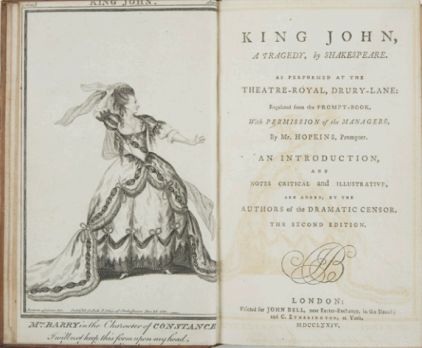
A broken set of the first “acting edition” of Shakespeare’s Plays, as They Are Now Performed at the Theatres Royal in London … survives in the Mullock collection (vols. 3, 4, and 9). Published by the enterprising John Bell in 1774, it was dedicated to David Garrick, who had spearheaded the first Shakespeare festival in Stratford five years earlier. Opening with ornate letterpress title pages, this popular edition offered few annotations, but was spiced up with numerous illustrations (some engraved by Charles Grignion the younger) of actors performing their parts, for example, Mr. Smith in duelling mode as Richard III and Mrs. Buckley in the character of Mistress Ford in The Merry Wives of Windsor). Bell’s edition omitted lines from plays that had been cut for performances and allowed Francis Gentleman, author of The Dramatic Censor (1770), who furnished the introduction, to remove “glaring indecencies.” It also perpetuated Nahum Tate’s adaptation of King Lear which ended happily ever after with Lear and Cordelia remarkably alive.
Mullock had a quaint miniature duodecimo Shakespeare set dated 1803, at least two-thirds of which remain: volumes 1 through 4, 7, and 9. Printed in London by C. Whittingham of Dean Street in Soho, “Sharpe’s Edition” was published by John Sharpe, opposite York House, Piccadilly, and H. D. Symonds of Paternoster Row. The frontispiece offers up a medallion portrait of an elderly looking bard looking left. Starting with The Tempest, this edition has been pared down to the bare essentials apart from a glossary at the end of the last volume. These tiny volumes would have been ideal for reading in Bannerman Park. Mullock also had Shakspear’s [!] Dramatic Works, edited by the Rev. W. Harness, printed and sold in London by J. F. Dove in 1830 (missing vols. 3 and 4 out of 8). This has a good reproduction of Martin Droeshout’s 1623 frontispiece portrait. The spines to volumes 1 and 8 have been reinforced by green and brown tape. Mullock also had a one-volume Plays of William Shakspeare, edited by Samuel Maunder, published in London by L. A. Lewis in 1853.