Rev. R. K. Naylor
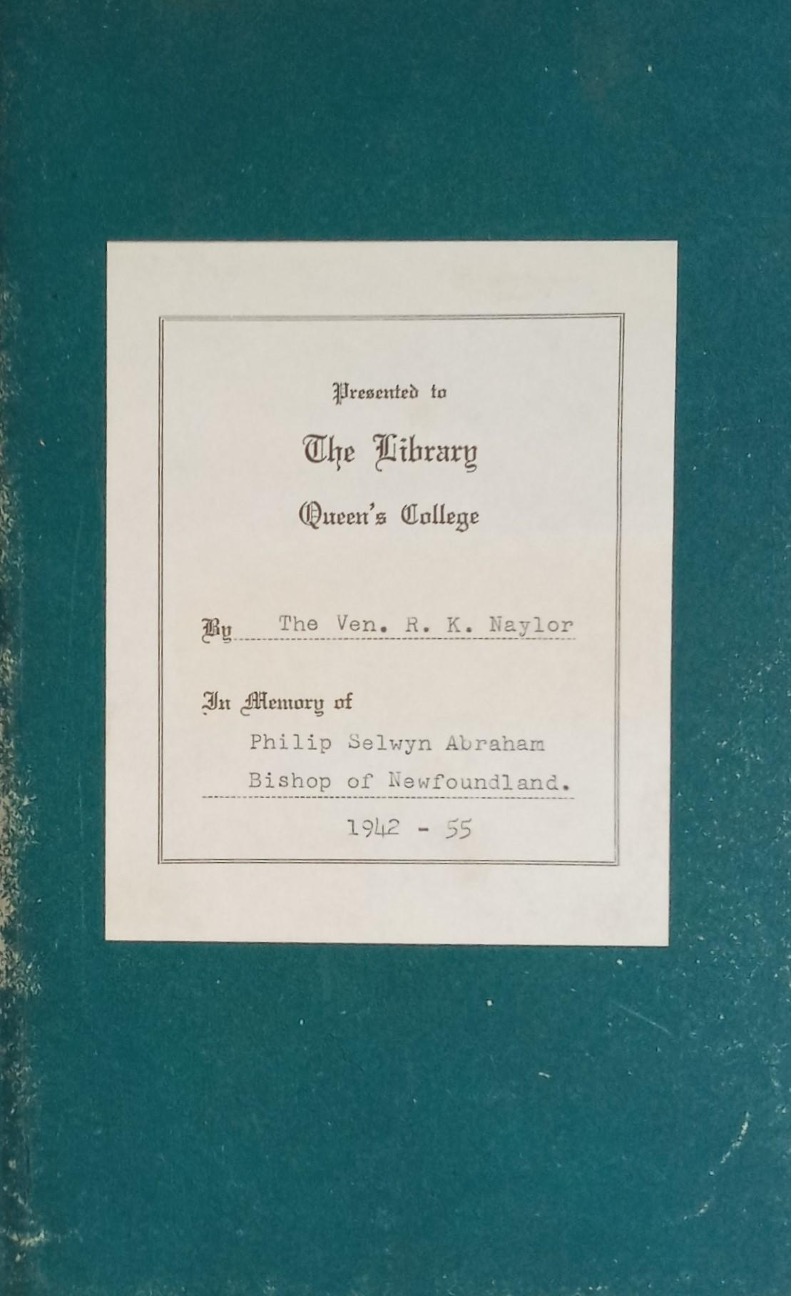
Reverend Reuben Kenneth Naylor was born in Shawville, Quebec, on December 16, 1885, and died on March 8, 1971. Little is known about his nuclear family, except that he was the son of the aforementioned William Herbert Naylor. According to The Montreal Diocesan Theological College: A History from 1873 to 1963, he held many titles during his life. A man heavily involved in academics, he served as both tutor of the preparatory class from 1906 to 1908 and as lecturer of classics from 1907 to 1912 at McGill University. He won several academic distinctions, including the Gault Gold Medal, when he graduated in theology in 1912. Over the next several decades, he held positions as tutor and/or lecturer in theology and New Testament Language and Literature. He served as rector of Rawdon from 1912 to 1925 (the first to hold the position) and of Trinity Memorial College in Montreal from 1940 until at least 1963 (the exact date of his retirement from this position could not be found). He also served as canon of Christ Church Cathedral, was a member of the general synod, and was both a member and prolocutor of the provincial synod. Like his father before him, he eventually became an archdeacon, specifically archdeacon of Montreal, a position to which he was appointed in 1956. His name appears on several texts in the Queen Elizabeth II Library, written as R. K. Naylor, Reverend Kenneth R. Naylor, and Kenneth Naylor. One, The Bible as History: A Confirmation of the Book of Books, appears to be a gift to Naylor from one “Magic Tom” Aubrey. Another, The Primitive Christian Catechism: A Study in the Epistles, bears the handwritten phrase “Kenneth Naylor with the best wishes of the author,” implying that the author himself, Philip Carrington, gave this book to Naylor. Other texts bearing Naylor’s name also indicate his ownership at some point in time. There is no definitive source confirming that he visited Newfoundland, but he may have been acquainted with Philip Selwyn Abraham, who served as bishop of Newfoundland from 1942 to 1955; the 1809 Book of Common Prayer bearing his name affirms that it was presented to the library by Naylor in Abraham’s memory. This is the only text that explicitly states in writing that it was a direct donation by Naylor.
Donation List:
Carrington, Philip. The Primitive Christian Catechism: A Study in the Epistles. Cambridge: University Press, 1940.
Church of England. The Book of Common Prayer, and Administration of the Sacraments, and Other Rites and Ceremonies of the Church, According to the Use of the United Church of England and Ireland: Together with the Psalter or Psalms of David, Pointed As They Are to Be Sung or Said in Churches; and the Form and Manner of Making, Ordaining, and Consecrating of Bishops, Priests, and Deacons. Oxford: Clarendon Press, 1809.
Driver, S. R. An Introduction to the Literature of the Old Testament, 8th ed. Edinburgh: T. & T. Clark, 1909.
Etheridge, J. W. The Targums of Onkelos and Jonathan Ben Uzziel on the Pentateuch; with the Fragments of the Jerusalem Targum: From the Chaldee. London: Longman, Green, Longman, and Roberts, 1862.
Etheridge, J. W. The Targums of Onkelos and Jonathan Ben Uzziel on the Pentateuch; with the Fragments of the Jerusalem Targum; From the Chaldee. London: Longman, Green, Longman, Roberts, and Green, 1865.
Keller, Werner and William Neil. The Bible as History—A Confirmation of the Book of Books. New York: William Morrow and Company, 1956.
Sanday, William. The Authorship and Historical Character of the Fourth Gospel: Considered in Reference to the Contents of the Gospel Itself. London: Macmillan and Co., 1872.