Bernard Picart and the Religions of the World
Between 1826 and 1830, when Bishop Mullock was a student of philosophy and theology in Spain and Italy, he acquired a beautifully engraved volume entitled Cérémonies et coutumes religieuses de tous les peuples du monde (Religious ceremonies and customs of all the peoples of the world). Published in Amsterdam in 1723 by Jean-Frederic Bernard (1683–1744) and Bernard Picart (1673–1733 [spelled as Picard in the original edition]), it had been placed on the Index of Prohibited Books in 1738 for its critical approach to Roman Catholicism. The book was ambitious in both its breadth and its intent, and it remains a remarkable call for religious tolerance.
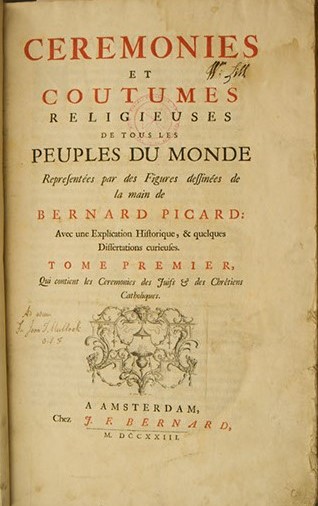
The original work consists of seven volumes containing detailed descriptions and depictions of a global range of religious practices. While the Mullock collection includes only the first volume, which focuses on Judaism and Catholicism, the other six discuss the Greek Orthodox Church, Protestantism, Islam, Confucianism, Hinduism, Buddhism, and various indigenous religions of North and South American peoples. By presenting each religious system as equivalent, Cérémonies et coutumes religieuses was one of the first works of the early Enlightenment to demonstrate that diverse religious beliefs and practices could be considered as equally valid. The book’s publisher and author, Jean-Frederic Bernard, and its well-known engraver, Bernard Picart, were French Calvinists who had sought refuge in the Dutch Republic after French king Louis XIV refused to protect Protestants in 1685. Their experiences of religious persecution in France led them to promote the radical idea that all religions are equally worthy of both respect and criticism and that people throughout the world display universal tendencies in their sacred practices and beliefs.
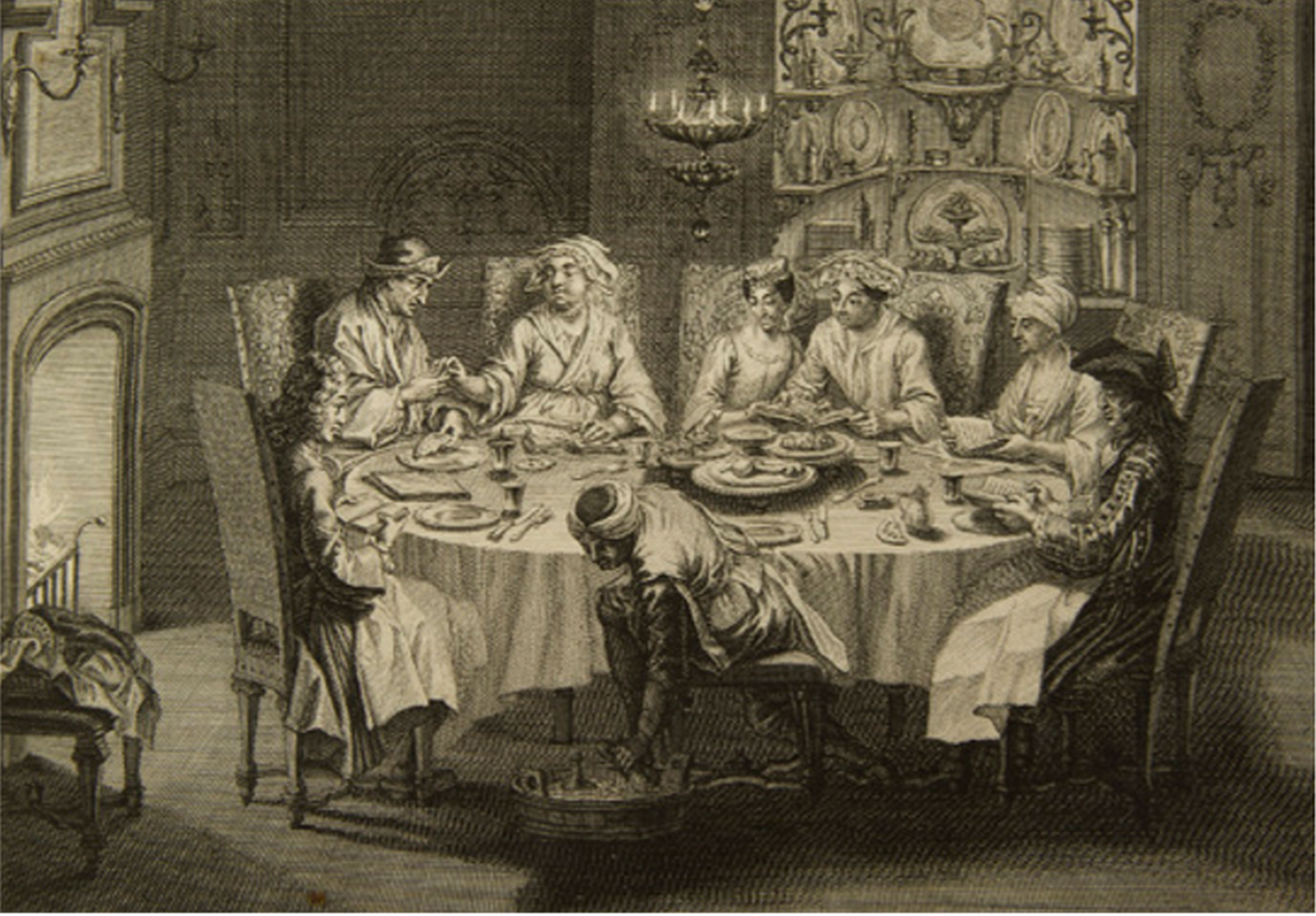
In an attempt to avoid the widespread ethnocentrism of contemporary Europe and a deep-rooted disdain for other religions, Bernard and Picart tried to present objective, balanced, and accurate descriptions of diverse religious customs in both the text and the engravings of the book. Bernard was meticulous in surveying the most up-to-date and respected sources for his writing, and he relied as much as possible on indigenous and first-hand accounts. An early proponent of the ethnographic approach, he argued that Europeans could not judge other religions without better understanding their practioners’ languages and being able to read their books. Similarly, Picart based his detailed engravings on extensive personal experience when possible, and endeavoured to depict religious practices from the point of view of the participants. He spent considerable time establishing relationships with the Jewish community in Amsterdam, and, after four years, was finally allowed to participate in their religious ceremonies. His engraving of a Sephardic (Portuguese) Jewish family gathered for a Passover Seder illustrates his ability to sensitively and authentically portray sacred customs, and his engravings remain as some of the best sources of information about Dutch Jewish life in the eighteenth century.
Written in an era of widespread anti-Semitism and religious upheaval, and when most European works depicted non-Christian customs as simply deviant, Cérémonies et coutumes religieuses was a stunning contribution to religious tolerance. The book enjoyed remarkable success, and by the time Mullock acquired his volume in the 1820s, it had been translated into Dutch, English, and German, had sold over 6,000 copies, and had been widely reprinted, pirated, and plagiarized. English versions of Bernard and Picart’s volume continued to be published in various forms as late as 1841. Mullock’s decision to add Cérémonies et coutumes religieuses to his Newfoundland collection illustrates an appreciation for critical understandings of religion and an openness to the merits of beliefs and practices other than his own. This intellectual independence is also reflected in the collection’s French-language Le Koran and Thomas Clarke’s History of Intolerance; with Observations on the Unreasonableness and Injustice of Persecution, and on the Equity and Wisdom of Unrestricted Religious Liberty (Waterford, 1819), which Mullock acquired in 1860.
Cérémonies et coutumes religieuses remains a reminder of the value of both respect and critical thinking in efforts today to achieve increased religious tolerance and mutual human understanding.