As the Mullock collection contains volumes associated with Port-Royal, it is worth considering the extraordinary intellectual vitality of this institution in seventeenth-century France. Founded as an abbey for women in 1204, Port-Royal flourished under the patronage of the eminent Arnauld family, from the late 1500s onwards. The community, which included nuns and Solitaires—laymen turning to the convent for a life of reflection and piety—eventually embraced Jansenism, a religious doctrine that promoted austerity, challenged royal absolutism, and opposed the Jesuits on many theological and philosophical fronts. It also created the Petites Écoles, schools dedicated to fostering academic excellence through innovative pedagogical methods. Its pupils include the famous playwright Jean Racine. At the heart of major controversies in France for decades, Port-Royal was regularly persecuted and the cloister itself was ultimately burned to the ground in 1711, at the behest of Louis XIV. Its exceptional legacy, however, lived on and has relevance today.
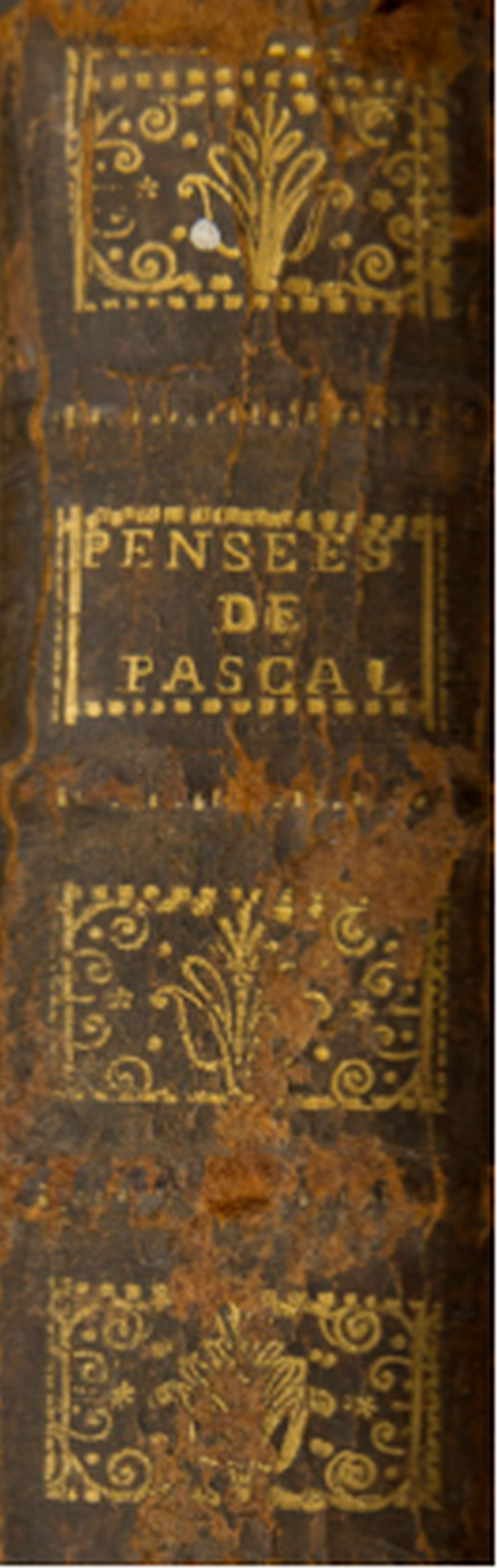
Pascal's Pensées de M. Pascal sur la religion, & sur quelques sujets
Gold-tooled spine of Blaise Pascal's Pensées de M. Pascal sur la religion, & sur quelques sujets (Paris: Desprez, 1734).
Courtesy of the Basilica Museum-Mullock Library, St. John's, NL.
The most celebrated of its members is without a doubt Blaise Pascal (1623–1622). A brilliant and precocious mind, he discovered two new fields of research in mathematics when he was still in his twenties. Following a mystical experience, however, he turned to God and philosophy, moving to Port-Royal, where he immediately took on the defence of Antoine Arnauld, a Jansenist who was facing eviction from the Sorbonne and perhaps even imprisonment for his religious positions. The result was Pascal’s Provinciales, a series of letters written to the head of the Jesuit order. Their instant and spectacular success may be attributed to their popular appeal. Vitriolic and brimming with irony, the Provinciales belong to the polemical epistolary genre. Privileged from the very beginning by Christianity with Paul’s correspondence, letters became heavily codified during the Middle Ages under the weight of the church. The genre was revived with the rise of humanism, only to culminate with the Provinciales. Pascal’s letters are cogent, mordant, and simply a pleasure to read, representing as such a clear break from the type of long, arid essays that was too often characteristic of the period. Such is the incisiveness and originality of Pascal’s style that the Provinciales are seen by many as the catalyst of French Classicism (Molière, Corneille, Racine, etc.) and the inspiration behind other polemicists such as Voltaire.
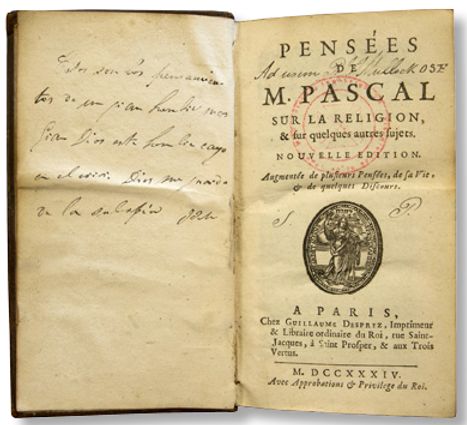
Pascal's Pensées de M. Pascal sur la religion, & sur quelques sujets
Title page of Blaise Pascal's Pensées de M. Pascal sur la religion, & sur quelques sujets (Paris: Desprez, 1734).
Courtesy of the Basilica Museum-Mullock Library, St. John's, NL.
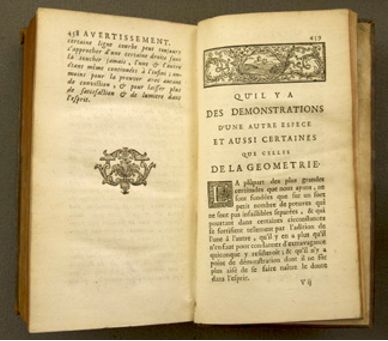
Pascal's Pensées de M. Pascal sur la religion, & sur quelques sujets
Pages 458 & 459 of Blaise Pascal's Pensées de M. Pascal sur la religion, & sur quelques sujets (Paris: Desprez, 1734).
Courtesy of the Basilica Museum-Mullock Library, St. John's, NL.
Pascal’s driving ambition, however, remained his Apology of the Christian Religion, the intended title of what is today known as Les Pensées, which was placed on the Index of Prohibited Books in 1789. It is an unfinished opus, and early editions of the text not only deliberately left out a number of important fragments but they also made the mistake of presuming that Pascal had bequeathed them at random. It was not before the middle of the nineteenth century that commentators began to suspect an order behind the various notes and that the book’s argument could in fact be substantially reconstituted. As a result, recent editions are far more coherent and exhaustive than the work in the Mullock collection. Still, even in this eighteenth-century volume, one is quickly struck by the profound and lucid assessment of the human condition depicted by Pascal, revealing the Pensées as one of the most seminal studies of modernity alongside the writings of Baruch Spinoza, Immanuel Kant, and René Descartes.
Mullock also had a copy of Pierre Nicole’s Continuation des Essais de Morale: Contenant des Reflexions Morales sur les Epitres et Evangiles (The Hague, 1700) and volume 3 of the eighth edition of Essais De Morale: Contenus en Divers Traitez Sur plusieurs devoirs importans (The Hague, 1700). Nicole (1625–1695) was a close friend of Pascal and one of the most important pillars of Port-Royal. Erudite, he wrote on many subjects including theology, aesthetics, and logic. Prompted by the bishop and theologian Jacques-Bénigne Bossuet and in line with his strict rationalism, Nicole also wrote a virulent criticism of mysticism. Nicole is perhaps best remembered, however, for having authored a series of essays on morality, eventually collected together under the title Essais de morale. The popular appeal and success of these treaties is corroborated by the fact that they were republished in four volumes from 1687 to 1688, as Continuation des essais de morale, which included studies on liturgical texts. The Mullock collection contains the second of these volumes.