Mullock and John Henry Newman
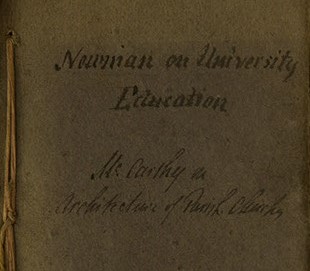
The Mullock collection contains John Henry Newman's Discourses on University Education: Addressed to the Catholics of Dublin, which consists of several addresses. On the title page the owner is identified as “Fr Joan. T Mullock. O. S. Franci / Epus S. Joan. T N / 1857.” It is bound together with J. J. McCarthy, Suggestions on the Arrangement and Characteristics of Parish Churches (Dublin, 1851).
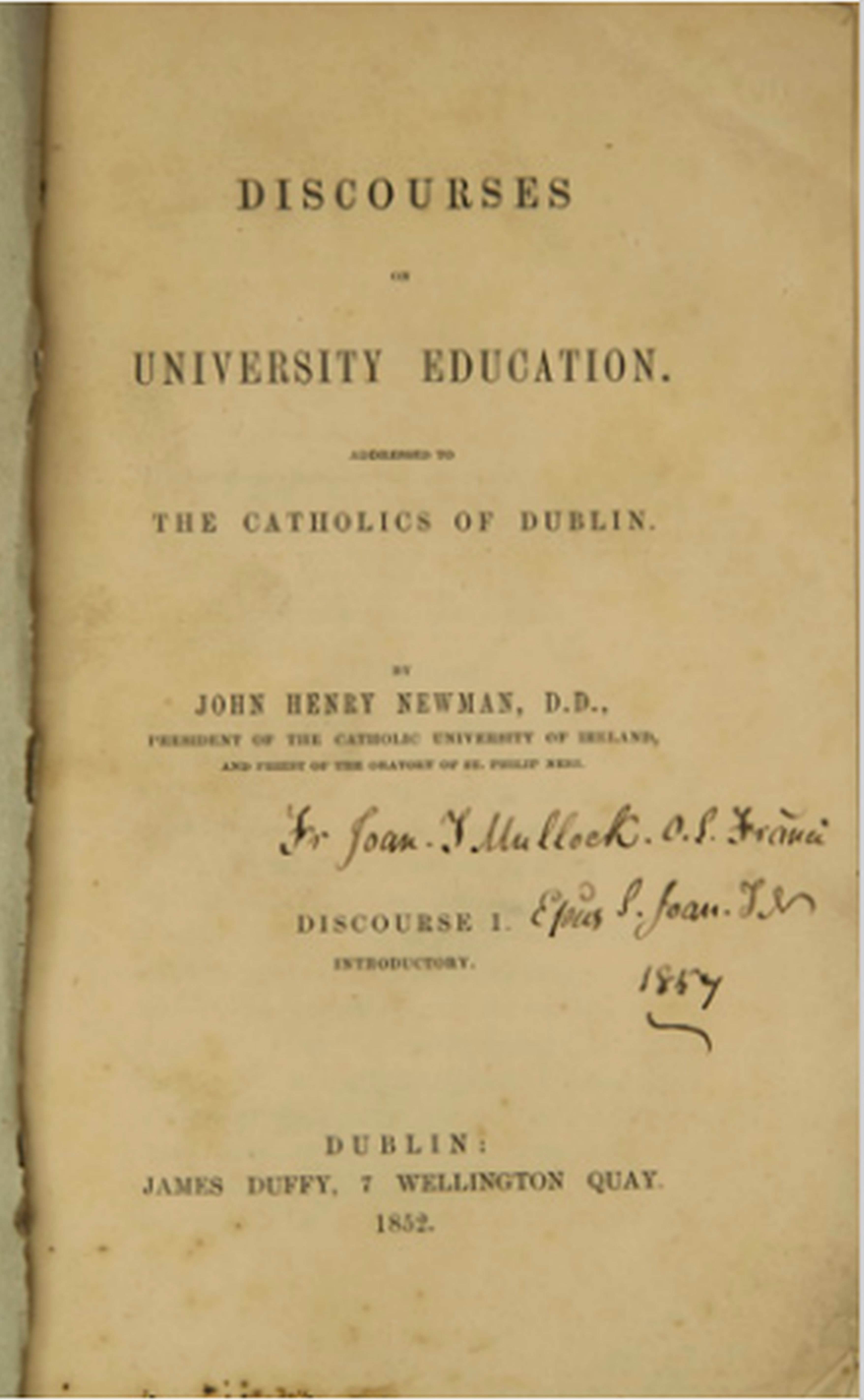
Discourses on University Education by the Roman Catholic convert and future cardinal, who had been a leader in the Anglican Oxford Movement, is a direct outcome of Newman's involvement in the establishment of the Catholic University of Ireland, whose first rector he became. Newman had been asked by Archbishop Paul Cullen of Armagh (previously rector of St. Isidore's in Rome) to advise the Irish episcopate on the organization and staffing of a Catholic University and, if he had the time, to deliver “a few lectures on education” (Ker, 376). Newman gave five lectures in May and June of 1852 before large public audiences in Dublin. In the same year, augmented by five additional written discourses and an appendix and preface, these lectures were published by James Duffy in Dublin. (The publication date is 1852, but it came off the presses in February 1853.) Newman gathered these works together with other lectures and publications on education and science that had been issued in the later 1850s into his famous The Idea of a University, which was published under the title The Idea of a University Defined and Illustrated: I. In Nine Discourses Addressed to the Catholics of Dublin; II. In Occasional Lectures and Essays Addressed to the Members of the Catholic University in London in 1873.
Newman's Discourses on University Education in the Mullock collection represents a spirited defence of the need for a Catholic university. Rejecting with Archbishop Cullen so-called mixed institutions, he advocated what also Pope Pius IX and the Sacred Congregation for the Propagation of the Faith had wanted, a Catholic university for the Irish and the English-speaking Roman Catholics. Education in such a university would be different from the “godless education” available in the so-called Queen's Colleges or in Dublin's Trinity College, which was under Protestant dominance. Newman incorporated his familiarity with the Oxford system into the plans for this Catholic university and its liberal education, with the difference that the teachers and students of the envisioned institution would be Roman Catholics. In such a comprehensive university, Newman argued, theology had its legitimate place in the curriculum and could be excluded only at the risk of impoverishing the pantheon of sciences. Colin Barr summarizes the heart of Newman's Dublin discourses: “that knowledge is a whole from which no piece can be excluded without fatally weakening what remained, and that theology is indispensable to a university education” (84). But the university Newman envisioned was more than a mere seminary or a research institute. Knowledge cultivated in a community of teachers and learners included the capacity to gain insight and form mature judgments, so that students would be equipped through education for their various roles in life. They were steadied in this endeavour by being rooted in a faith community. It was believed that such an expansive view of a liberal university education would create an intellect that “takes a connected view of old and new, past and present, far and near, and which has an insight into the influence of all these one on another; without which there is no whole, and no centre. It possesses the knowledge, not only of things, but also of their mutual and true relations; knowledge, not merely considered as acquirement, but as philosophy” (Discourses, 214).
While Newman argued his case for Catholic higher education in Ireland, Bishop Mullock also envisioned in a February 22, 1857, Pastoral Letter, a Catholic educational institution that would provide a solid secondary and even post-secondary education for the island's Roman Catholics. The bishop considered education as “the most important of all subjects in a social, a national, and a religious point of view; as not only our happiness here, but our eternal welfare hereafter, depends on the education we receive.” Mullock thought that “only under the guidance of the Catholic Church … true education can be found” and that, from its beginnings, the Catholic church “has always been the teacher and civilizer of the world.”
Mullock recounts in this letter his efforts in St. John's of having begun “in the old Episcopal Residence a School and Seminary where … children may be prepared by a solid, a refined, and a Catholic Education for any situation in life.” He had in mind a wide curriculum that prepared young Catholics in commerce and science as well as the liberal arts “for any profession they may wish to adopt.” This school would be a college and seminary in which also teachers and 40 boarders as well as 300 day scholars could be accommodated. Mullock had hopes that the college might “be enlarged, if necessary, even to the dimensions of a University.” Such an undertaking would require “the best professors we can procure, the most improved scientific apparatus, the most select works for the library, everything in fact that can promote education …” Like in Ireland, so also in Newfoundland, Pope Pius IX, Mullock reported to the faithful, had taken a special interest in this project and granted a plenary indulgence to all contributors to it.
To encourage continued support of the diocesan St. Bonaventure's College, Mullock reminded island Catholics of the Irish University, Dublin, to which they had contributed in the past; and he was full of hope that with the dawn of higher education also “a new era is now dawning on the country; wealth, commerce and population are increasing.” A similar optimism is also expressed a few years later in Mullock's Two Lectures on Newfoundland, in which he is certain of Newfoundland's auspicious future, where the combined effects of religion, education and industry produce “future prosperity” and “a great people” (60). Mullock's Victorian progressivism found expression also in his interest and involvement in laying the transatlantic cable as well as establishing steamship connections with the United States.