Mullock and the Transatlantic Cable
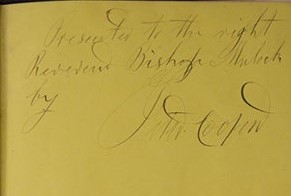
Charter, Trust Deed, and By-Laws of the Cooper Union for the Advancement of Science and Art: with the Letter of Peter Cooper, Accompanying the Trust Deed, a set of guidelines for the Cooper Union, was presented by Peter Cooper to Bishop Mullock.
Mullock had an interest in progress in his adoptive homeland in general, and the colony’s communications and transportation in particular. In 1850 Mullock had publicly expressed his desire for a transatlantic cable link between North America and Europe that would pass through Newfoundland, an idea that later commentators attributed to him. Only a few years later, in 1854, a group of investors formed the New York, Newfoundland and London Telegraph Company to lay transatlantic cable. American industrialist Peter Cooper became president of the company, which by 1866 had successfully established communications across the Atlantic. Cooper visited St. John’s in connection with his business, and he dined with Mullock on several occasions during those visits.
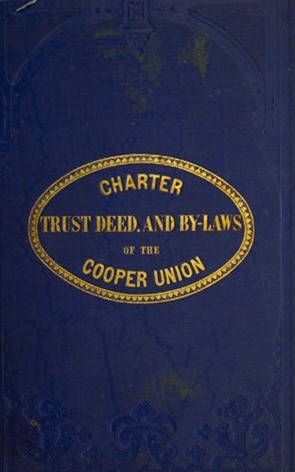
In the same period that Cooper was building the telegraph line across the island of Newfoundland and the Cabot Strait and endeavouring to lay a cable across the Atlantic, he also founded the Cooper Union for the Advancement of Science and Art. This privately managed educational institution in New York was endowed by Cooper and offered free tuition to working-class students. It was “Christian” but non-sectarian, and exemplified his belief that science and education could resolve social and political problems. The two men may have discussed education as well as communications, since they also shared this interest. Unlike the Cooper Union, Mullock’s foundation, St. Bonaventure’s College, was intended primarily to educate the Catholic community in St. John’s. However, both Mullock and Cooper were interested in the promotion of commercial and scientific education.
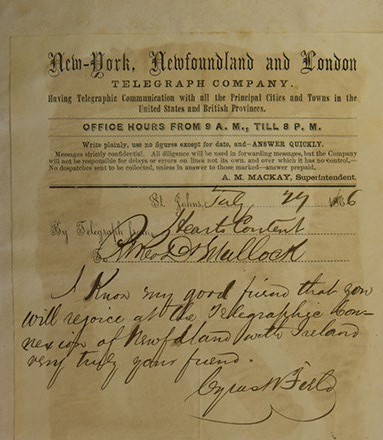
There are two other indications of Mullock’s interest in the transatlantic telegraph cable in the bishop’s book collection. Mullock pasted two telegrams dated July 27, 1866, the date of the successful completion of the cable, into Jacques-Paul Migne’s Troisième Encyclopédie Théologique, volume 55 (Paris, 1865). The first announces the completion of the work—“Atlantic Cable a perfect success. Fleet arrived at H[eart’s] Content 8 this morning. All well [Mcaulan?]—while the second reveals Mullock’s personal connection to the project and to one of the founders of the New York, Newfoundland & London Electric Telegraph Company. It reads, “I know my good friend that you will rejoice at the Telegraphic connection of Newfoundland with Ireland very truly your friend Cyrus Field.”