Mullock and Protestantism
Bishop Mullock’s 1847 translation of Alphonsus de Liguori’s The History of Heresies is the first known translation of this work into English. In Italian, as in English, it is a monumental work, addressing and refuting heresies in every century from the first to the eighteenth. Mullock translated Liguori’s three-volume work into two volumes and extended its scope by adding a chapter on the developments which had transpired in the 60 years since Liguori’s death. A survey of Mullock’s supplementary chapter reveals that he not only sought to bring Liguori’s work up-to-date but also to correct Liguori’s perceptions and academic judgments on the topic of the Reformation in England. For his supplementary chapter, Mullock referenced works in English and French published between 1681 and 1861 in places as diverse as Derby, Dublin, London, New York, Paris, Philadelphia, and Waterford. Thirteen of these titles remain within the Mullock collection.
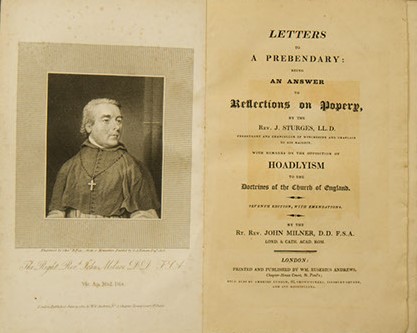
Mullock addressed the effects of the Reformation in England and particular challenges to Roman Catholicism arising from the Church of England, especially those to papal supremacy and Anglican claims about Apostolic Succession. To craft his correction and extension of the source text of Liguori’s The History of Heresies, he most likely consulted Francis Patrick Kenrick’s The Primacy of the Apostolic See Vindicated (1845); Peter Richard Kenrick’s The Validity of Anglican Ordinations and Anglican Claims to Apostolical Succession Examined, 2nd ed. (1848); Louïs Maimbourg’s Remarques d’un theologien sur le traité historique de l’établissement et des prérogatives de l’eglise de Rome et de ses evêques (1688); J. Sturges’s Letters to a Prebendary; Being an Answer to Reflections on Popery (1843); and William Wake’s Exposition du catechisme de l’eglise Anglicane, où sont expliquez les principes de la religion Chrétienne. Avec un formulaire de Prières, pour le matin & pour le soir, a l’usage des familles (1722)
.
Mullock included two references which dealt with the effect of the Reformation in Ireland and, in particular, its effect on Roman Catholic clergy. The Mullock collection contains Patrick F. Moran and Oliver Plunket’s Memoirs of the Most Rev. Oliver Plunket, Archbishop of Armagh, and Primate of All Ireland: Who Suffered Death for the Catholic Faith in the Year 1681 (1861) and J. K. L.’s A Reply by J. K. L. to the Late Charge of the Most Rev. Doctor Magee, Protestant Archbishop of Dublin, Submitted, Most Respectfully, to Those to Whom the Above Charge Was Addressed (1827). Oliver Plunket would not be beatified until 1920, and canonized in 1975, yet Mullock considered his story illustrative of the Irish Catholic church.
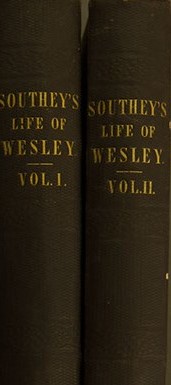
In addition to the challenges posed by the Church of England, Mullock was also concerned with the development of Methodism. He dealt with this movement, later a Christian denomination, in his supplementary chapter, drawing upon Joseph Benson’s An Apology for the People Called Methodists; Containing a Concise Account of Their Origin and Progress, Doctrine, Discipline and Designs (1801) and volume 1 of Robert Southey, Charles C. Southey, Daniel Curry, Alexander Knox, and Samuel T. Coleridge’s The Life of Wesley: And Rise and Progress of Methodism (1847).