The Mullock-Fleming Breviary
Mullock was consecrated bishop in the chapel at St. Isidore’s, Rome, on December 27, 1847. Coadjutor with right of succession to Bishop Michael Anthony Fleming, he was consecrated titular bishop of Thaumacene (in partibus infidelium). While Mullock was in Rome in early 1848, he purchased a “Perpetual Directory for Dr. Fleming” and recorded this purchase in his notebook. What Mullock terms a “Perpetual Directory” is known today as a “breviary,” from the Latin breviarium. It is a book or number of books containing all the texts for the Liturgy of the Hours, sometimes referred to as the Divine Office or the Prayer of the Church: the psalms, readings from Scripture, writings from the early church fathers and mothers and the saints, prayers, and hymns. These would be prayed every day of the year, through the seasons of Advent, Christmas, Lent, Easter, and Ordinary Time, including feast days.
Psalters were used in monastic communities from the earliest times as an aid to communal prayer. St. Benedict developed a psalter for use in his community as early as 550 CE Traditionally, the Hours prayed in monastic communities, all of which are reflected in the Fleming-Mullock breviary, were the canonical hours of Lauds (morning prayer) offered at sunrise, Prime (first hour, usually 6 a.m.), Terce (third hour, or mid-morning), Sext (sixth hour, or midday), None (ninth hour, or mid-afternoon), Vespers (evening prayer) at sunset, and Compline (night prayer) before going to bed. The monks also arose to read and pray during the night. This Office of Matins (Readings) likewise had its divisions, into nocturnes, corresponding to the beginning of each of the “watches of the night” (Ps. 63:6), that is, 9 p.m., midnight, and 3 a.m. The basic structure of the Liturgy of the Hours has remained constant since the eleventh century.
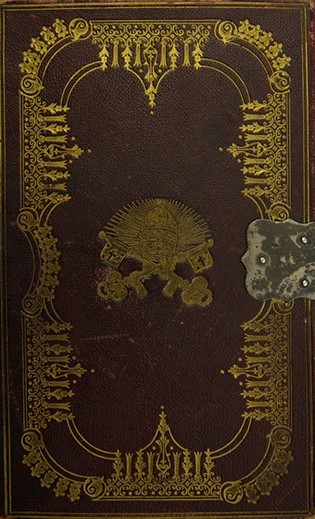
The beautifully preserved Fleming-Mullock breviary, published in Mechelen, Belgium, has a version of the Liturgy of the Hours developed for the Franciscan community, of which both Fleming and Mullock were members. The breviary consists of three volumes bound together in a red, gold-tooled leather binding, reinforced by metal corner pieces, and held together by a silver clasp. In the centre of the cover embossed in gold is the papal crest of Pope Pius VI (pope from 1775 to 1799). Inside the binding, the volume opens up into three removable volumes, each for different seasons of the church year. The breviary is thus made to be more portable.
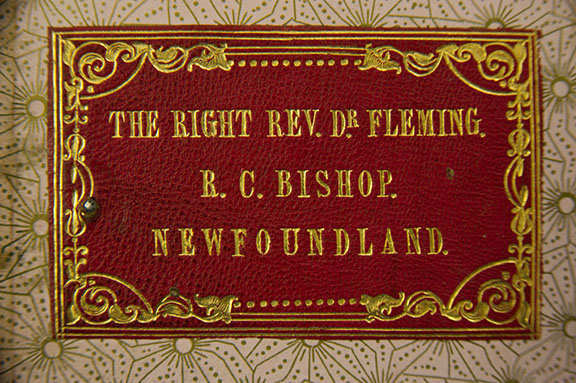
On the inside of the front cover, a red leather frontispiece, tooled in gold, contains the words “THE RIGHT REV’D. DR. FLEMING, R.C. BISHOP, NEWFOUNDLAND,” which indicate that it was intended as a gift to Bishop Fleming. The title page of the first volume has the signatures of both Fleming and Mullock, indicating that Mullock took possession of the breviary after Fleming’s death in 1850.
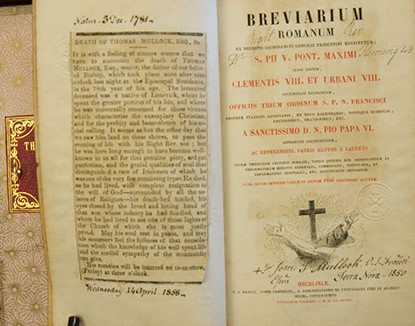
Immediately opposite, Mullock pasted in a newspaper obituary for Thomas Mullock, his late father. A turn of the page reveals a newspaper report of his funeral. On the rear flyleaf and pastedown of the same volume, Mullock pasted an epitaph of Thomas Mullock written in Latin and English by Enrico Carfagnini, president of St. Bonaventure’s College, and on the preceding flyleaf a poem entitled “Emigrant’s Cry” by Rev. Dr. Faber, a nostalgic lament of an Irish emigrant for a lost homeland. These inclusions attest to Mullock’s regard for his father as well as his predecessor bishop, both of whom were Irish emigrants, with whose memories Mullock prayed every day.