Mullock and Alphonsus de Liguori
“There are few saints, the study of whose lives would be more productive or of more utility to us than that of St. Alphonsus,” wrote Bishop Mullock in 1846 in the preface to his The Life of St. Alphonsus M. Liguori. Alphonsus de Liguori (1696–1787), the founder of the Congregation of the Most Holy Redeemer (the Redemptorists) and bishop of the Diocese of Sant’Agata de’ Goti (1762–75), was beatified in 1816, canonized in 1839, and proclaimed a Doctor of the Church in 1871. He was also a renowned lawyer, preacher, writer, artist, musician, poet, and theologian. Liguori’s published works amount to some 111 volumes. Credited with being the first bishop to write in the vernacular (modern Italian), he is the only author whose works exist in more editions than those of William Shakespeare. Of his many devotional works, A Way to Converse Continually with God as a Friend, The Practice of the Love of Jesus Christ, The Way of the Cross, and the Visits to the Blessed Sacrament and to Mary continue to be widely used in the Roman Catholic tradition.
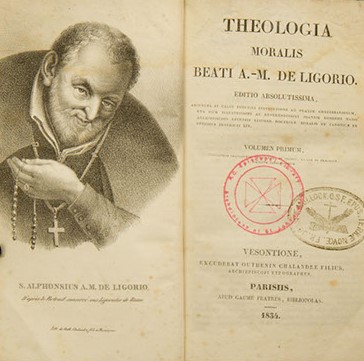
Ligouri’s scholarly works, several of which remain in print, have shaped generations of theologians. His greatest contribution may have been his Theologia moralis (Moral theology). First published in 1748, this work has been continuously in print. It shaped a pastoral approach to ethical issues and decision-making by positing a middle ground between the strict rigorism of the Jansenist approach (in matters of moral choice the stricter course should be taken) and laxism (in matters of moral choice the easier course should be taken). This approach is sometimes referred to as equiprobabilism (or a system of principles designed to guide the conscience of one in doubt whether he or she is free from or bound by a given civil or religious law).
Ligouri, who had a great devotion to the Blessed Virgin, wrote a number of Marian texts, most notably The Glories of Mary. Primarily pastoral in nature, his Marian writings rediscovered, re-stated, and defended the Mariology of Augustine, Ambrose, and other early church writers, and offered an intellectual defence of Mariology in the midst of the eighteenth-century Enlightenment. This renewed Marian theology contributed to the 1854 proclamation of the dogma of the Immaculate Conception. Mullock was one of the first scholars to introduce Liguori’s works to an English-speaking audience. In 1846, he wrote the first biography of Liguori in English. In 1847, he translated Liguori’s The History of Heresies and Their Refutation and may also have translated his other devotional works.
Why was Mullock so fascinated by Liguori? One clue might be found in the fact that the canonization hearings for Liguori took place while Mullock was living in Rome. In Liguori, Mullock found what he believed to be a model for a modern bishop. In his preface to The Life of St. Alphonsus M. Liguori, Mullock stated, “In the life of St. Alphonsus Liguori … we have a man, I may say, of our own time, living within the influence of the ideas that rule our own age, mixed up with all the occurrences that checquer our daily existence. His days were spent in discharging the same duties as millions of his contemporaries; and he was a saint only because in the discharge of those duties, he sought above all, the glory of God and the salvation of souls.”
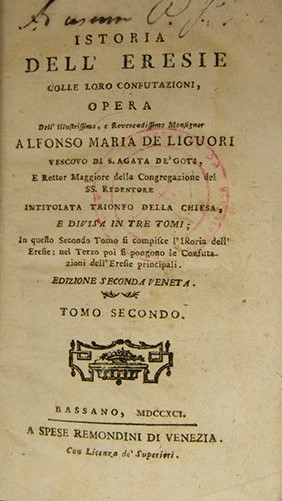
The Mullock collection’s eighteenth- and nineteenth-century editions of the works of Liguori include Dissertazioni teologiche-morali appartenenti alla vita eterna, likely purchased by Mullock in Rome around the time of the canonization hearings. The collection also includes three volumes of Istoria dell’ eresei colle loro confutazioni. Mullock purchased volumes 2 and 3 of the 1791 edition in Rome in 1832.
He seems to have found it impossible to acquire the whole set at that time, so he bought a later edition of volume 1 (1822) in Ireland. The collection also includes different sets of the Theologia Moralis, including Gaume Fratres’ 1834 Parisian edition. Among the unsigned books in the collection are other spiritual, pastoral, and devotional works by Liguori in Italian, English, and French, acquired by Mullock after his move to Newfoundland. Mullock seemingly wanted to make available a complete set of Liguori’s works not only for himself but also for his seminarians. Mullock expressed his attraction to Liguori and his works in his translator’s preface to The History of Heresies: “St. Alphonsus never sought for ornament; a clear, lucid statement of facts is what he aimed at; there is nothing inflated in his writings. He wrote for the people, and that is the principal reason, I imagine, why not only his Devotional Works, but his Historical and Theological Writings, also, have been in such request.”