Mullock and Confederation
In 1860, Robert Hunter, George McLean Rose, and François Lemieux formed the printing and publishing firm of Hunter, Rose and Company, and in 1864 received a five-year contract as printer to the Province of Canada. In 1865 the Province’s capital in Quebec City moved to Ottawa and, by 1866, the firm, which published the parliamentary debates of the Canadian legislature, had moved with it. According to Mullock’s inscription on the title page, this copy of Parliamentary Debates was sent to him by the “Canada [sic] Parliament.”
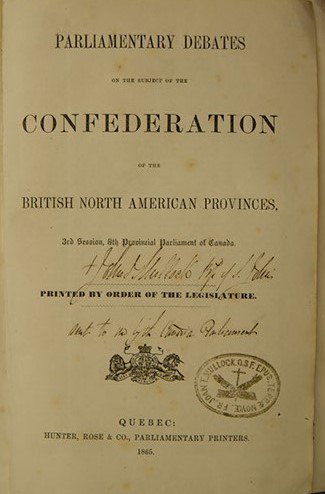
This was a period in which the United Provinces of Canada (now Ontario and Quebec) discussed a British North American union with the colonies of Nova Scotia and New Brunswick. Newfoundland was not essential to the success of this union, but the question of its joining the confederation became a political issue. The reading of a letter from Bishop Mullock (dated January 5, 1865) into the record by Solicitor General Hector-Louis Langevin may explain the presence of this volume of parliamentary debates in the Mullock collection. Mullock’s letter, which had been published in a newspaper, argued that education could be a great boon to Newfoundlanders. Disagreeing with the proper view that Newfoundland children did not need education since they were destined for the fishing boat, Mullock indicated that confederation could open up opportunities for young people to pursue other careers.
Not timid about political campaigning, Mullock had argued for responsible government, which was granted in 1855, as a way of giving political power to Roman Catholics. He alternately advocated and condemned the Liberal government when its members did not serve what he saw as the best interests of the colony. After the violence of 1861, however, he withdrew from the hurly-burly of partisan politics. Despite his statement incidentally favouring confederation, his view of the issue expressed in other writings was ambiguous. Like many other Irish-born and Newfoundlanders of Irish ancestry, he was wary of joining a largely Protestant country, not the least because of the potential threat to a “Catholic education” about which he felt so passionate. The industrialist Charles Fox Bennett (1793–1883) campaigned against confederation, arguing that the colony needed economic development. Mullock shared Bennett’s interest in progress but the bishop died, however, before the 1869 election that rejected confederation.