Richard Mant: The Book of Common Prayer
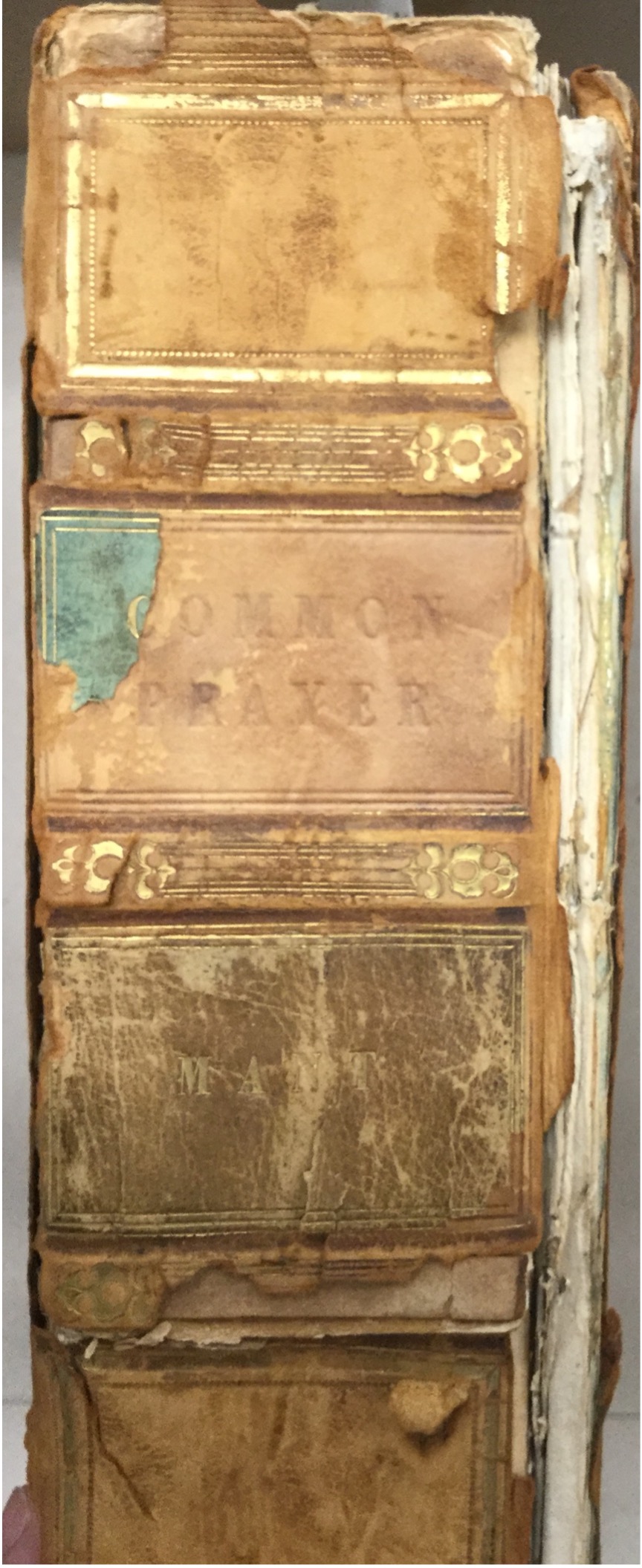
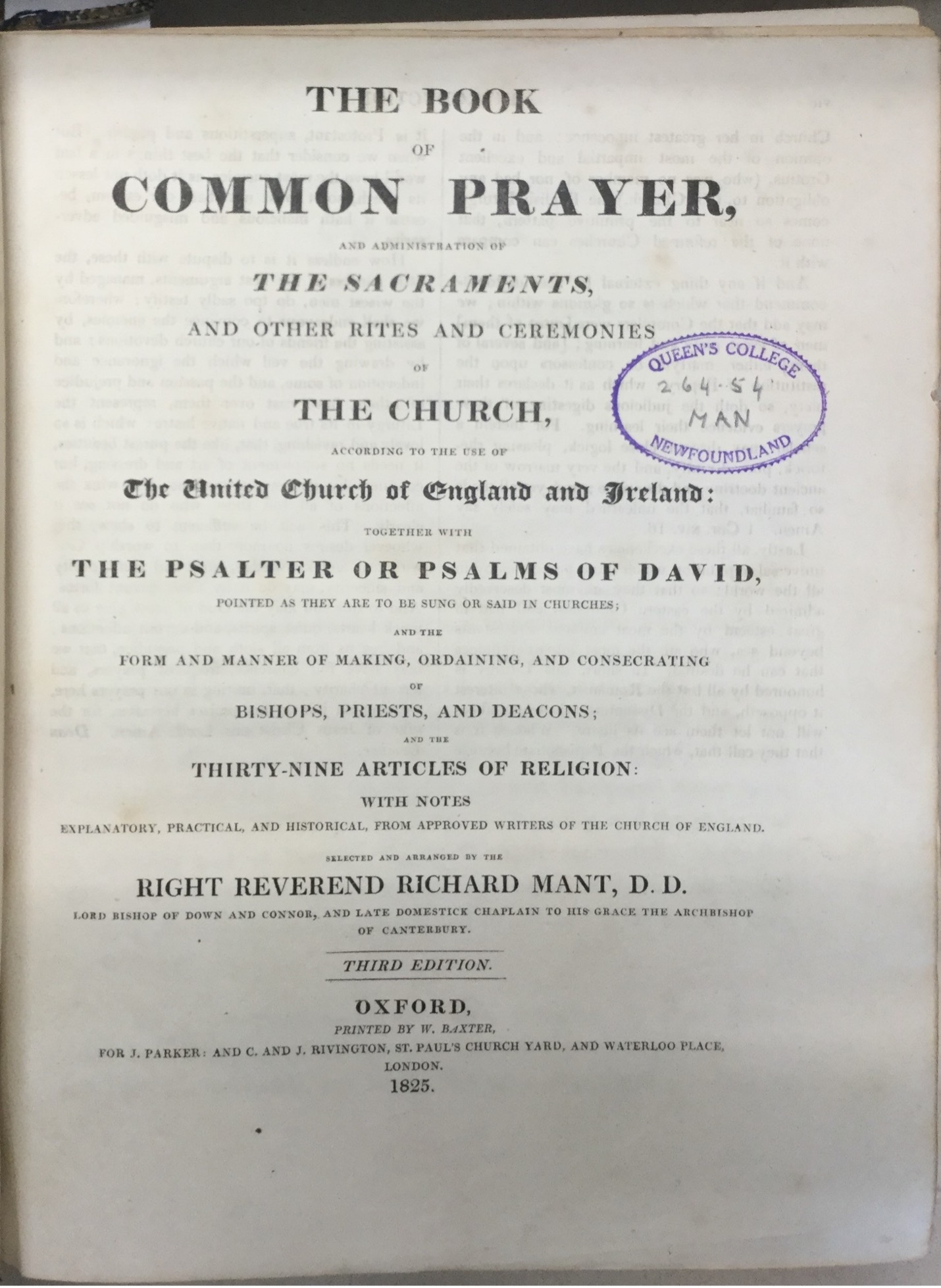
Feild complemented his collection of the Scriptures, both New and Old Testaments, with The Book of Common Prayer, and Administration of the Sacraments (Oxford: J. Parker and C. and J. Rivington, 1825). This book was edited by Richard Mant, who was concerned with how the Church of England gained its legitimacy from the apostolic succession. Mant (1776-1848), a bishop in Ireland overseeing the Down, Connor, and Dromore dioceses (Gordon 1), was educated in Trinity College (1793) and Oriel College (1798), where the Oxford Movement was later started by Newman, Keble, Pusey, and their associates. Yet Mant was not directly involved with the Tractarians; instead, he dedicated his time to furthering his religious and literary career as a poet, which was influenced by popular hymns and the Roman Breviary (2). As an author and editor, Mant worked closely with the Society for Promoting Christian Knowledge to publish an annotated Bible in 1814; he edited and published a prayer book in 1820, with a second edition released in 1825. Even though Mant was not an active Tractarian, he believed that the best way to protect the Church of England’s sanctity was to safeguard its traditions that linked it to the early church.
In the introduction, Mant cites Thomas Comber’s The Original of the Book of Common Prayer, and the Several Alterations, Which were Made in It to argue that Roman Catholicism’s dominance over scriptural interpretation was problematic. As a priest, Comber (1645-99) was famous for his “formidable output as a liturgical writer and Church of England polemicist” (Bethmont 1). Rémy Bethmont argues that Comber used his book A Companion to the Temple and the Closet to “vindicate the excellence of the Restoration Liturgy and to encourage the English to attend daily prayer in church” (2). Mant uses Comber’s work to argue against the papacy’s declaration that the Bible should only be translated into Latin and that new Christian faiths did not have the right to reinterpret the Scriptures’ traditions.
In addition, Mant included Dr. Robert Sanderson’s “Preface to the Book of Common Prayer” to emphasize the importance of English Protestantism’s unity under the Church of England. Sanderson (1587-1663) served as Charles I’s chaplain during the English Civil War of 1642 to 1651, and after the Restoration, was ordained as the bishop of Lincoln in 1660, despite his Calvinist beliefs (McGee 2). This bishop argues that England’s religious authorities were wise to “keep the mean between the two extremes, of too much stiffness in refusing, and of too much easiness in admitting any variation” from the Scriptures (xxiv). Mant includes Sanderson’s writings with Comber’s to demonstrate how the greatest threat to the Church of England during the nineteenth century was Christianity’s division into opposing factions based on differing interpretations.
As a Tractarian, Feild would have adhered to similar arguments that Mant’s commentators made about the importance of upholding the Church of England’s apostolic traditions. Feild’s ownership of this Bible, in addition to other books on sacramental and doctrinal discussion, suggests that the Anglican bishop was interested in learning about how prior theologians examined the development of the English church’s understanding of clerical authority.