Mullock and Irish Politics: William Smith O'Brien
Politician, revolutionary, and cultural creator William Smith O’Brien (1803–64), second son of Sir Edward O’Brien (4th Baronet) and Charlotte Smith, from whom he took his middle name, was educated at Harrow School and Trinity College, Cambridge University, and was admitted to the bar at Lincoln’s Inn. Raised at Cahirmoyle House, the estate of his mother’s family, and by culture trained to be a country gentleman, O’Brien ran for and was elected to Parliament and served from 1828 to 1831 as Conservative member of parliament for Ennis, and in 1835 stood as an independent Whig member of parliament for Limerick. Though at first a supporter of Irish union with Britain, he became a supporter of Daniel O’Connell’s Catholic Emancipation movement, and in 1843 during O’Connell’s imprisonment for seditious advocacy of the repeal of the Union of Ireland with Britain, O’Brien led the anti-union Repeal Association.
By 1846, however, O’Brien and other members of the Young Ireland Movement, including Thomas Francis Meagher (whose St. John’s-born father had been a merchant in the Irish-Newfoundland trade and the first Roman Catholic mayor of Waterford in 400 years), parted ways with O’Connell, believing that his advocacy of non-violent protest no longer served Ireland’s interests. In July of 1848, the Young Irelanders raised an unsuccessful rebellion of landlords and tenants against British rule in three Irish counties. At trial O’Brien was found guilty of high treason and sentenced to be hanged, drawn, and quartered, but public petitions for clemency resulted in his sentence and those of his comrades being commuted to transportation for life to Van Diemen’s Land (Tasmania). A great lover, collector, and advocate of the Irish language, prior to his detention O’Brien had presented Irish-language manuscripts to the Royal Irish Academy, and, after, he wrote from Van Diemen’s Land encouraging his son to learn the language. After five years, O’Brien was released on condition that he never return to Ireland. He relocated to Brussels but in 1856 was given an unconditional pardon and returned to Ireland in July, contributing to the Nation newspaper.
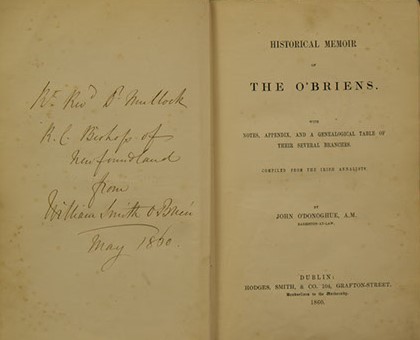
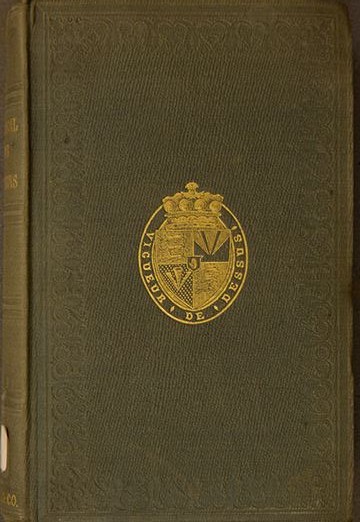
In February 1859, en route via ship to America, O’Brien and his son stopped in St. John’s for a brief visit. The St. John’s paper The Patriot for February 21 reported that, while in port, “Mr. O’Brien was the guest of Rt. Rev. Dr. Mullock” at the Palace. The two exchanged political views and books, and later reports claimed that O’Brien informally addressed a large crowd from the steps of the Cathedral. On arrival on February 20 in New York, O’Brien was greeted by Meagher, whom he had not seen for eight years. “I could not take his hand without emotion,” O’Brien wrote, “when I called to mind the many occasions upon which our homes, fears and suffering had been nearly identical.” It was from New York that O’Brien sent Mullock his Principles of Government with an inscription dated May 23, 1859. A year later he sent Mullock a copy of his Historical Memoir of the O’Briens, which he signed May 1860.