James Ware and the History of the Church in Ireland
Sir James Ware (1594–1666) was the leading Irish historian and antiquarian of his time besides being auditor-general and member of parliament for the University of Dublin. Having graduated from the recently founded Trinity College, Dublin, Ware dedicated himself to collecting manuscripts and original documents relating to Irish history. In the course of 40 years, he published a number of substantial historical works all concerned with the promotion of Ireland’s rich heritage. For a person of his time, he was remarkably unprejudiced and was the friend and collaborator of Catholic scholars. He was the first to publish the Elizabethan accounts of Ireland by Edmund Campion and Meredith Hanmer, and the Elizabethan poet Edmund Spenser’s View of the Present State of Ireland (1633). He also compiled a biographical register of Irish writers. His comprehensive history of Ireland, De Hibernia et antiquitatibus eius disquisitiones, which provides a detailed account of Irish families, names, customs, natural phenomena, and Irish fighting styles, appeared in London in 1654.
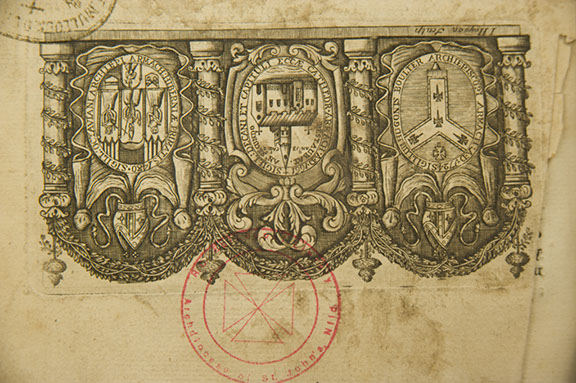
Ware’s history of Irish bishops, De praesulibus Hiberniae commentarius (1665), was translated into English by the historian Walter Harris (1688–1761), who was inspired by his second wife, Elizabeth Ware, great-granddaughter of Sir James, to make Ware’s Latin historical works accessible in English. Mullock owned the first edition of The Whole Works of Sir James Ware concerning Ireland. His copy of volume 1, The History of the Bishops of That Kingdom, was part one of a three-volume set (only two were published). Harris not only translated Ware’s work but he also edited and expanded it from 200 to 650 pages, adding an account of the history of Protestant bishops until 1739. Harris’s enlarged version of the history of the dioceses of Ireland, grouped under their respective archdioceses, begins with the Archdiocese of Armagh, the premier Irish see. The first page of each archdiocese bears a fine etching descriptive of the see, and, under the heading, a description of its coat of arms.
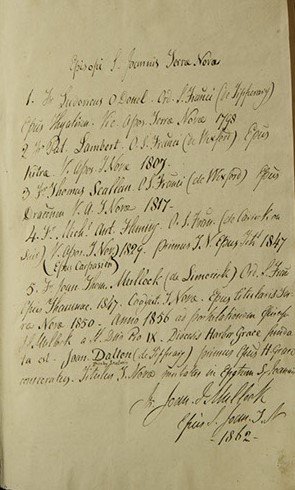
The text proper begins with a large, finely etched, dropped capital, also related to the diocese. At the end there is an elaborate index of the dioceses and the important events connected with them. On the opening page of his copy, Mullock listed in Latin all his predecessors as bishops of St. John’s, starting from Louis O’Donel, the first vicar apostolic of Newfoundland (1798). Mullock must have found Ware’s account particularly useful for his own scholarly endeavour to compose a history of the church in Newfoundland. As attested by his notebook, preserved in the Archives of the Roman Catholic Archdiocese of St. John’s, Mullock followed Ware’s research methods of collecting original documents and consulting extant sources and archival materials concerning the history of his own Irish see in the New World.