Edward Hyde: A Firsthand Account of the English Civil War of 1642-1651
Part of Feild’s book collection consists of studies on the English Civil War and its impact on the monarchy’s place in society, especially as the head of the Church of England. Specifically, Feild owned a copy of Edward Hyde’s The History of the Rebellion and Civil Wars in England to Which is Added an Historical View of the Affairs of Ireland (Oxford: The Clarendon Press, 1826), which covered Charles I’s execution by rebel forces. Hyde (1609-1674), a politician, dealt with governmental corruption, acting against officials who abused the law for their own desires and opposed authorities who demanded emergency funds as their right for political expenditures (Seaward 4). Charles I offered Hyde a post in his court after noticing his work in the Short and Long Parliaments, particularly his cooperation with Lords Falkland and Colepeper. Hyde also witnessed the beginnings of conflict between the Scots and the English government, resulting in the popular demand to end the episcopacy in 1640 (5-6). Although Hyde initially turned down Charles I’s offer, he would later join the king during the Civil War against Cromwell’s forces. Charles I knighted and appointed Hyde to his privy council in 1643, where he acted as one of the king’s main advisors (7). When it became clear to the king that he was losing the war, he ordered Hyde to escape England with his son Prince Charles (later Charles II) and to record the history of the royalist side of the Civil War for posterity (9). Hyde, the prince, and their entourage first travelled to the Scillies, a chain of islands off the west coast of England, then to the Island of Jersey, and finally to France.
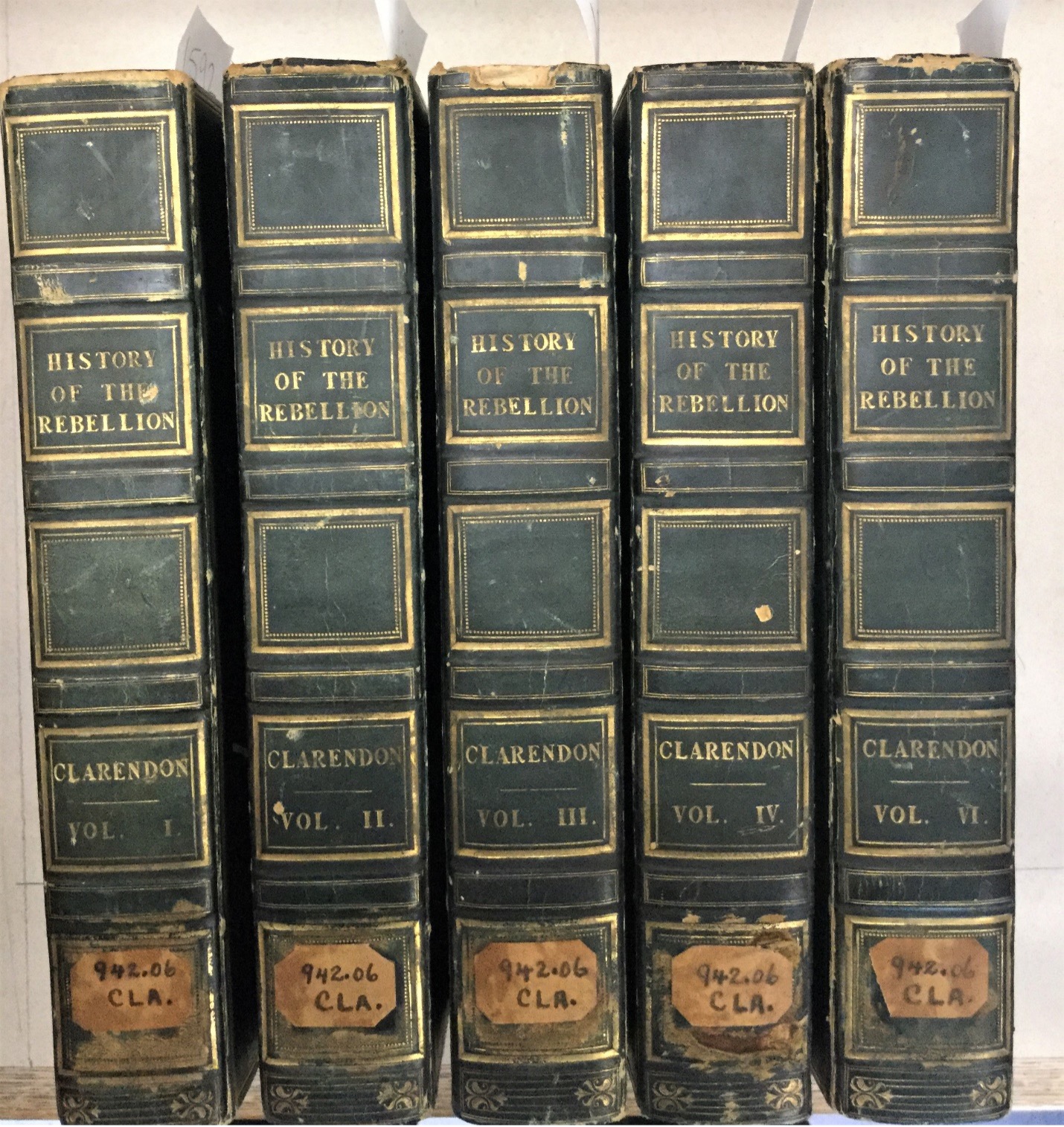
During this time Hyde began his history in the Scillies and would later finish his work in 1672 while staying in France. Hyde’s retelling of Cromwell’s Rebellion and its impact on the monarchy demonstrates how civil liberties and religious conformity often conflicted with one another. Hyde’s main purpose in writing The History of the Rebellion was to record what occurred in favour of Charles I, but after Charles II banished him from England, he expounded the dangers of governmental factionalism (Seaward vii).
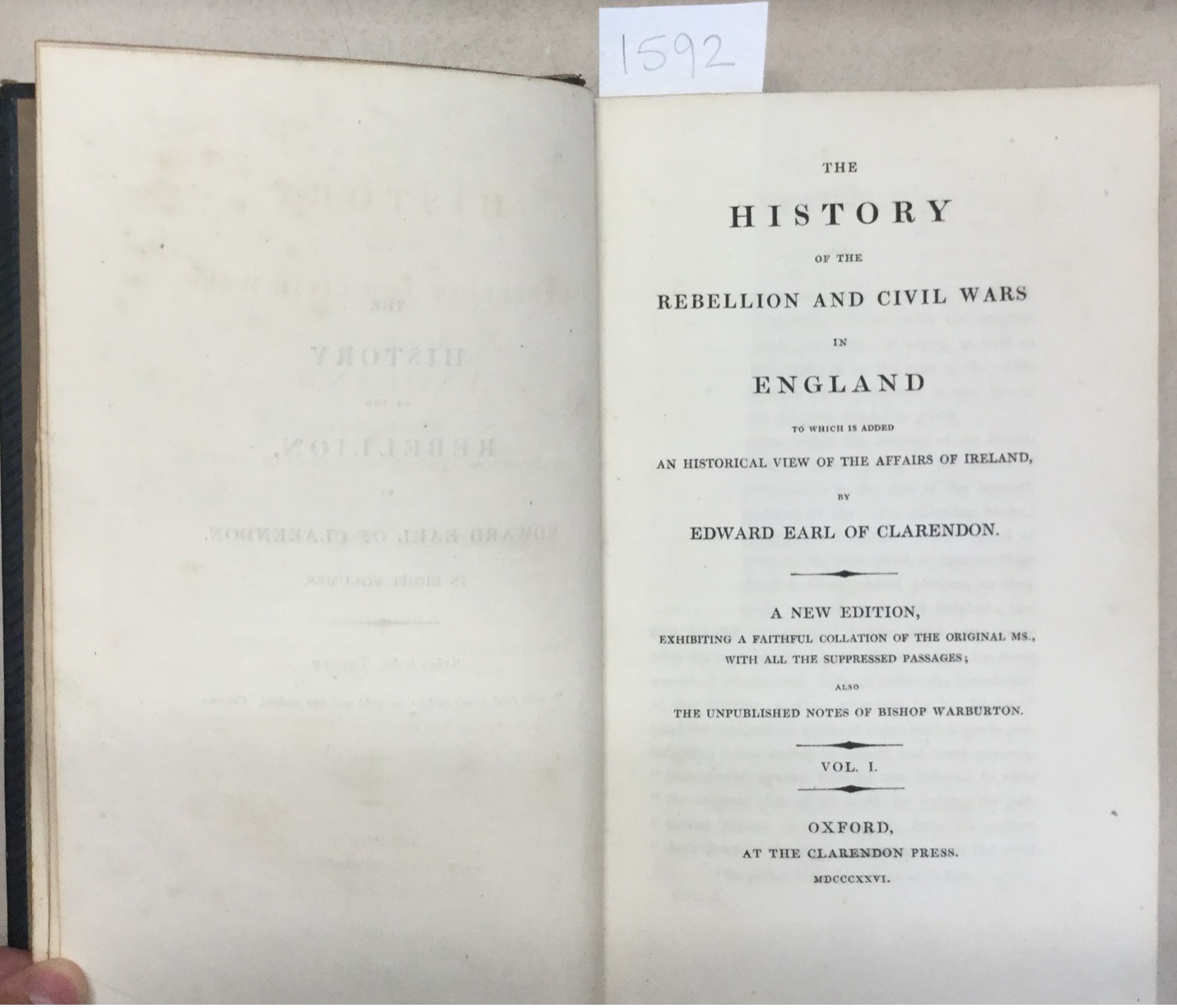
Feild’s copy of Hyde’s The History of the Rebellion was published by Bulkeley Bandinel in 1826. Appointed Bodley’s librarian in 1810, Bandinel (1781-1861) used his position to expand the library’s holdings and reprint books once held in the Bodelain Library that were too old or fragile to be kept in the collection (Clapinson 2). Among the books being replaced was Hyde’s eight-volume work, which Bandinel felt appropriate to release to the public through the Clarendon Press to open up a dialogue on the problems facing the English government. Bandinel believed that the same problems that led to the seventeenth-century Rebellion were reoccurring in the nineteenth: the government and the king’s court were dividing into competing factions.
For Feild, Hyde’s and Bandinel’s words would have justified his Tractarian position, that is, that the Church of England needed to regain its independence from secular control and to reestablish the clergy’s authority. Without control over its own devices, the church was threatened by government factions which wanted to use this religious institution for its own purposes.