Latin Classics: Horace and Persius
One of the prize editions from the eighteenth century is Richard Bentley's edition of Horace. Apart from being the foremost classical scholar of his age and controversial editor, Bentley was master of Trinity College, Cambridge. This Latin text of Q. Horatius Flaccus in the Mullock collection was first printed in Cambridge in 1711. Recognition on the Continent came with the printing of “Editio Altera” in Amsterdam “Apud ROD. & GERH.WETSTENIOS HFF.” in 1713. The Dutch edition was said to have been even better than the English one. The title page was printed in red and black with an exotic ornament featuring a circular medallion flanked by two sphinxes and two putti, one plucking a harp, the other blowing a trumpet. That the 1713 frontispiece matches the one in the first edition suggests co-operation between the Cambridge and Amsterdam publishers.
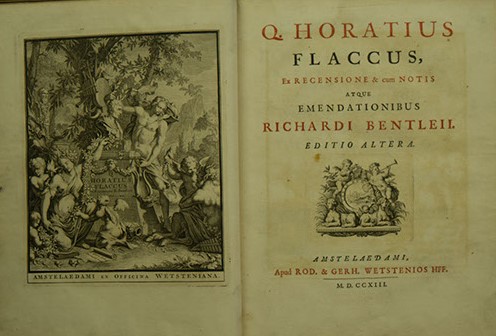
The copy in the Mullock collection is in quarto, bound in calfskin with gold inlay. Gold lettering appears on the spine, which has five raised bands, the bottom panel of which reads: “AMST. 1713.” The scuffed leather on the binding suggests that the volume was not just for show. Stronger evidence for this appears at the bottom of page 95 where a translation of the Latin verse on the page above (Carminum Lib. I. XXXVIII, “Ad Puerum”) has been pencilled in:
Persian entertainments, my boy, I hate:
Garland lime-skin-bound are to me displeasing
Cease to follow where the rose in places
Late is delaying
More than simple myrtle those need not toil—for
Keen to please me: neither on thee attendant
Myrtle’s awkward, neither on me who drink em-
-bowed by vine-leaves.
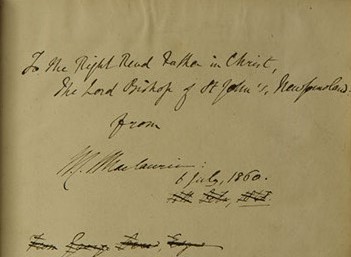
Fittingly, Mullock received his copy of Horace from William Cowper Maclaurin in 1860 after the latter became professor of classics at St. Bonaventure’s College. Maclaurin, an Anglican convert and former dean of Moray and Ross in Scotland, was recommended to the position at Mullock’s educational foundation by John Henry Newman.
Another classical selection in the Mullock collection turns out to be three separate texts of a first-century Roman writer bound together. The first is an anonymous English translation of The Satires of Persius, a “fourth” edition printed in Dublin by William McKenzie of Dame Street in 1787. The name of a previous owner, “Jos Story,” is dated April 26, 1803. A red stamp appears over the title, and Mullock signed his name below. “Joseph Story my book” appears in a large hand vertically through the text on the opening of “Mr Bayle's Life of Persius.” The second text was done by the same printer as the first in the same year, but has been completely reset. These Satires were translated by Thomas Sheridan, friend of Jonathan Swift and father of the famous playwright Richard Brinsley Sheridan. The third and final text bound in this volume is in Latin, edited by John Bond: Auli Persii Flacci satyræ sex. Yet another title page bears the name of the same Dublin printer: William McKenzie.