Greek-Latin Dictionaries
Cornelii Schrevelii lexicon manuale Graeco-Latinum et Latino-Graecum is a Greek-Latin/Latin-Greek lexicon published in Edinburgh in 1818 but was based on earlier lexica going back to the seventeenth century. The Mullock collection attests to a strong interest in the Greek and Roman classics. Mullock would also have wished to know ancient Greek in order to be able to read the Greek New Testament. Since the Renaissance, competence in both Latin and ancient Greek was considered the mark of an educated person. While students of ancient Greek today use dictionaries that give definitions in their own mother tongue, it was not uncommon in earlier centuries to provide Latin definitions for words in ancient Greek, usually considered the more difficult of the two languages. Bilingual facility would also have been encouraged in schooling of the time, which probably included exercises in prose composition. This lexicon would have allowed students to attempt to translate a Greek passage into Latin or vice versa.
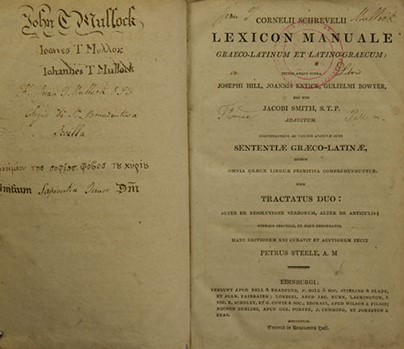
The lexicon is an expanded version of a popular Greek-Latin lexicon by the Dutch physician and scholar Cornelis Schrevel (1608–64). It was augmented in 1663 by the English scholar and clergyman Joseph Hill (1625–1707), an interesting figure who refused to accept the Act of Uniformity of 1662, which demanded conformity to certain prescribed forms of prayers and rites of the Church of England, and subsequently spent time abroad in the Netherlands before returning to England under Charles II. The lexicon then underwent further revision at the hands of the eighteenth-century English schoolmaster and scholar John Entick (1703–73), another interesting character who, among other things, fiercely attacked the government in a weekly newspaper column. This led to the seizure of his private papers under a general warrant in 1762; Entick then sued the authorities for illegal seizure, and won damages. The printer William Bowyer (1699–1777), who was known for his edition of the Greek New Testament, also helped edit the lexicon. Often scholarly tools such as this lexicon represent the accumulated labour of multiple scholars over several generations.
Mullock inscribed his copy of the lexicon with his name, his Franciscan order, the college where he was studying—St. Bonaventure's in Seville, Spain—and his home city of Limerick, Ireland. The book is also inscribed with the name of a previous owner, Thomas Patten of Great Georges Street, Dublin, and the date, 1823. Mullock presumably bought or otherwise received this book from Thomas Patten either in Ireland or at St. Bonaventure's College in Seville. Mullock appears to have amused himself with bilingual jottings on one of the blank pages near the beginning of the book: he wrote his name in English, in Greek letters, and in Latin. He also translated the phrase “the beginning of wisdom is fear of god” into both ancient Greek and Latin.