Nicolle de La Croix's Géographie moderne
Louis-Antoine Nicolle de La Croix (1704–60) was a Catholic abbot. His Géographie moderne is a gazetteer of the most up-to-date knowledge about the world’s populations and their governments, languages, and religions. In his preface, de La Croix emphasizes his desire to stimulate interest in geography among young persons and highlights the features he included with this intent. The gazetteer is preceded by Un petit traité de la sphere (A treatise on the sphere), which presents the by-then-surpassed geocentric vision of the universe. The Catholic church would not yet embrace the heliocentric model of the solar system until 1822. Un petit traité de la sphere, then, is a brave attempt to appear scientific while maintaining the denial of astronomical observation.
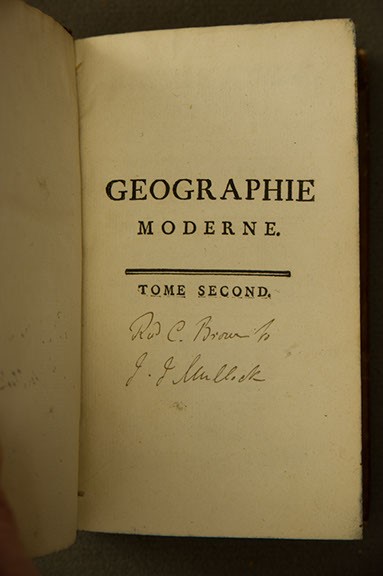
A lexicon of geographical terms follows, after which de La Croix presents the world, beginning with France and Europe before moving on to the other continents. European countries in particular are subdivided into their administrative regions; de La Croix gives a brief historical overview followed by a listing of notable features and major cities, ending with an inventory of possessions and colonies in the New World as well as in Africa and Asia. All in all, geography is seen as political and demographic rather than natural. In fact, Géographie moderne includes no maps and de La Croix suggests suitable atlases that the reader might consult. (Bishop Mullock had access, among other atlases, to the excellent detailed maps in the British Cyclopedia, published by Charles Partington [London, 1834].)
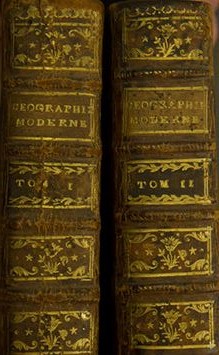
After a continent-by-continent survey of the world’s political jurisdictions, de La Croix includes sections on sacred geography and on ecclesiastical geography. The former is a survey of political entities in the Middle East from biblical times to the Crusades. The final section is a listing of the archbishoprics and bishoprics of the Roman Catholic world, a section that would have been a useful reference for Mullock. Immensely popular, Géographie moderne went through numerous editions and was occasionally pirated. It is a title still readily available in rare book auctions. Mullock’s two-volume set has brightly marbled endpapers and edges, ribbon bookmarks, and calf binding. Both volumes are in very good condition and appear to have been barely used. Mullock received his volume of Géographie moderne from Father Charles Browne, who inscribed the book at Adam and Eve’s in Dublin in 1838. At the same time, Browne also gave Mullock a French edition of the plays of Molière and Thomas Corneille.