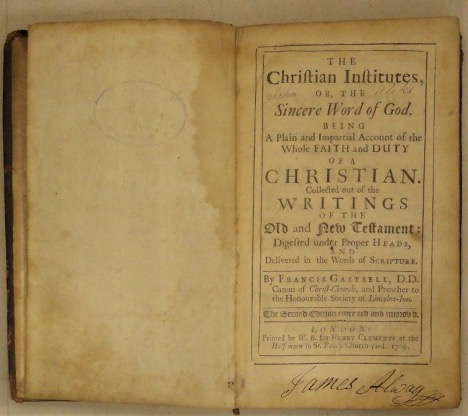
Gastrell and Bingham: The Trinitarian Controversy
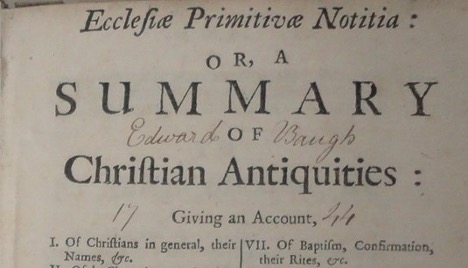
Feild believed that it was important to use the Church of England’s history in present theological debates, as shown by his owning Joseph Bingham’s Ecclesie Primitive Noitia: or a Summary of Christian Antiquities (London: E. Bell and J. Darby, 1722) and Francis Gastrell’s The Christian Institutes or, The Sincere Word of God (London: Henry Clements, 1709). Both texts dealt with the Trinitarian controversy, in which some theologians argued that God was separated into three different deities (Handley 1). During the eighteenth century, university scholars, theologians, clergymen, and church fathers debated the sanctity of this theory. For Feild, this controversy would have represented an important development in Church of England dogma and how to protect this institution’s traditions from unconventional ideas.
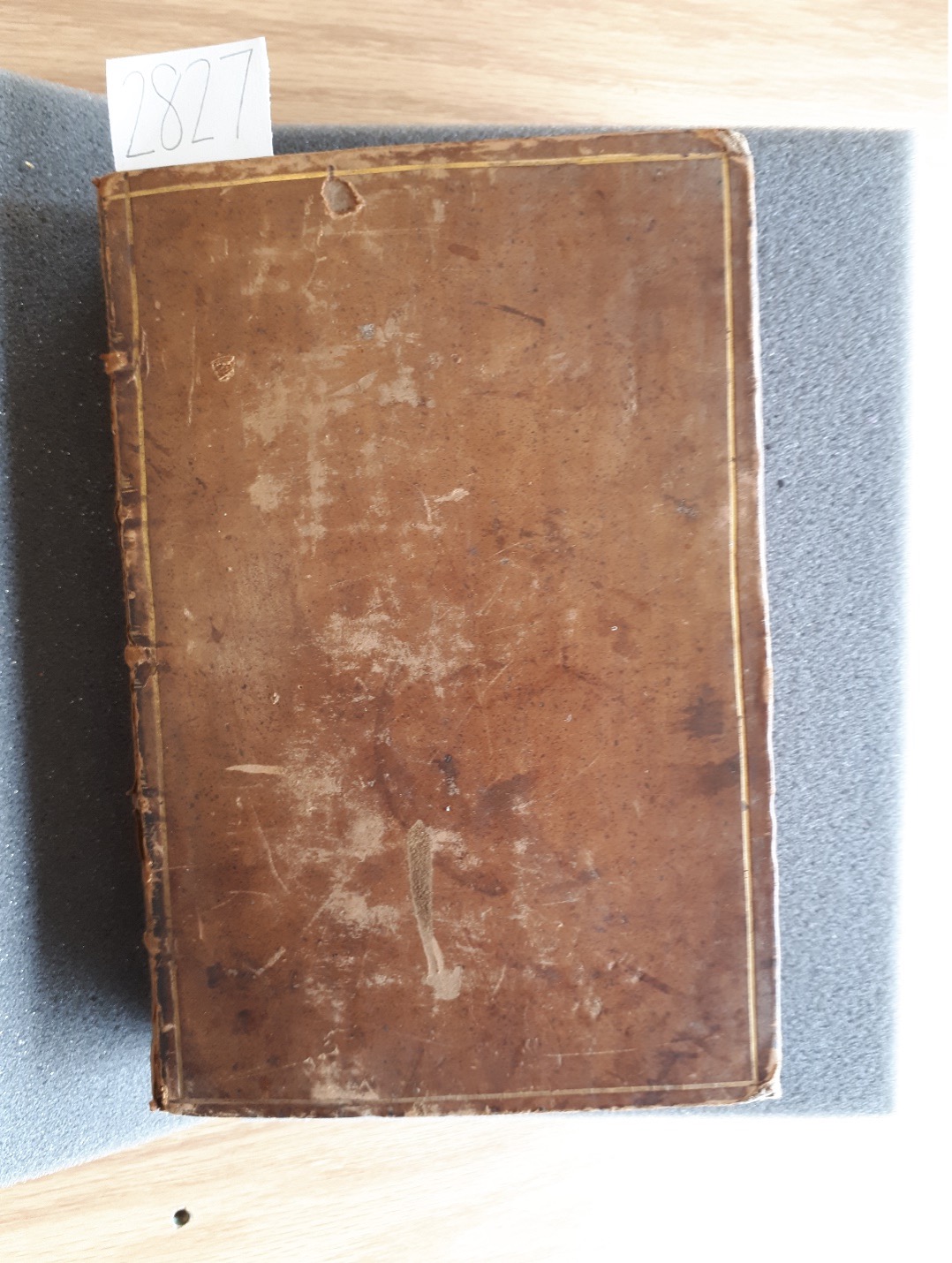
For example, Bingham (1668-1723), an Oxford-educated ecclesiastical historian, believed that it was his duty to “establish what the Fathers of the Church, rather than what the Schoolmen, had said on the subject” (Barnard 300). Bingham’s writings suggest that the Church of England during the eighteenth century was divided on opinions of scriptural interpretation between the religious authorities and the clergy who were educated by the English colleges. He preached a controversial sermon which used similar language and arguments to William Sherlock’s writings on the Trinity, namely, that God was separated into three deities represented by the Trinity (Cross and Livingstone 1). As a result, the Hebdomadal Board of Oxford responsible for dealing with religious controversies condemned Bingham’s sermon as heretical. He later resigned from his university position after many of his colleagues refused to work with him (Thianto 79-82).
In his study of the early church, Bingham examined how the language of the Scriptures had changed over time and how this development affected the interpretation of religious practices. It was necessary, he said, to reexamine the Scriptures, because “[u]nless we can be certain of the original usages of the first Christians, it will be impossible to distinguish who are now Primitives … [and] who are near Resemblances” (iv). Bingham advocated that people reform the “Primitive Church” and its true heir the Church of England to cleanse it from corruption and recover the true meaning of the Scriptures.
Whereas Bingham expressed controversial opinions about Trinitarianism, Gastrell (1662-1725) argued against William Sherlock. Gastrell, however, promoted the Church of England’s established doctrines, which “attracted the attention of the Archbishop of Canterbury, who appointed him the Boyle Lecturer for 1697,” canon of Christ Church in 1703, chaplain to the queen in 1711, and the bishop of Chester in 1714 (Brown 1).
Gastrell believed that the Scriptures came directly from God and could not be disproved. Instead, people continually misinterpreted these sacred texts, which resulted in controversial opinions like Sherlock’s position. To combat misinformation, Gastrell collected “out of the writings of the Old and New Testament, all the doctrines and precepts therein dispersed; to lay them together in such an order and method, as to give the Christian reader a full and distinct view of his whole faith duty at once” (xi). He offered his own commentary to guide his audience toward a proper understanding of these sacred texts to quell any dissent toward the Church of England’s doctrine. Gastrell hoped to persuade the “professed Enemies of Revealed Religion” (xiv) to return to orthodoxy and to understand God’s instructions. Gastrell’s writings are as much an educational text as they are a commentary on political events and controversies that surrounded the Church of England.
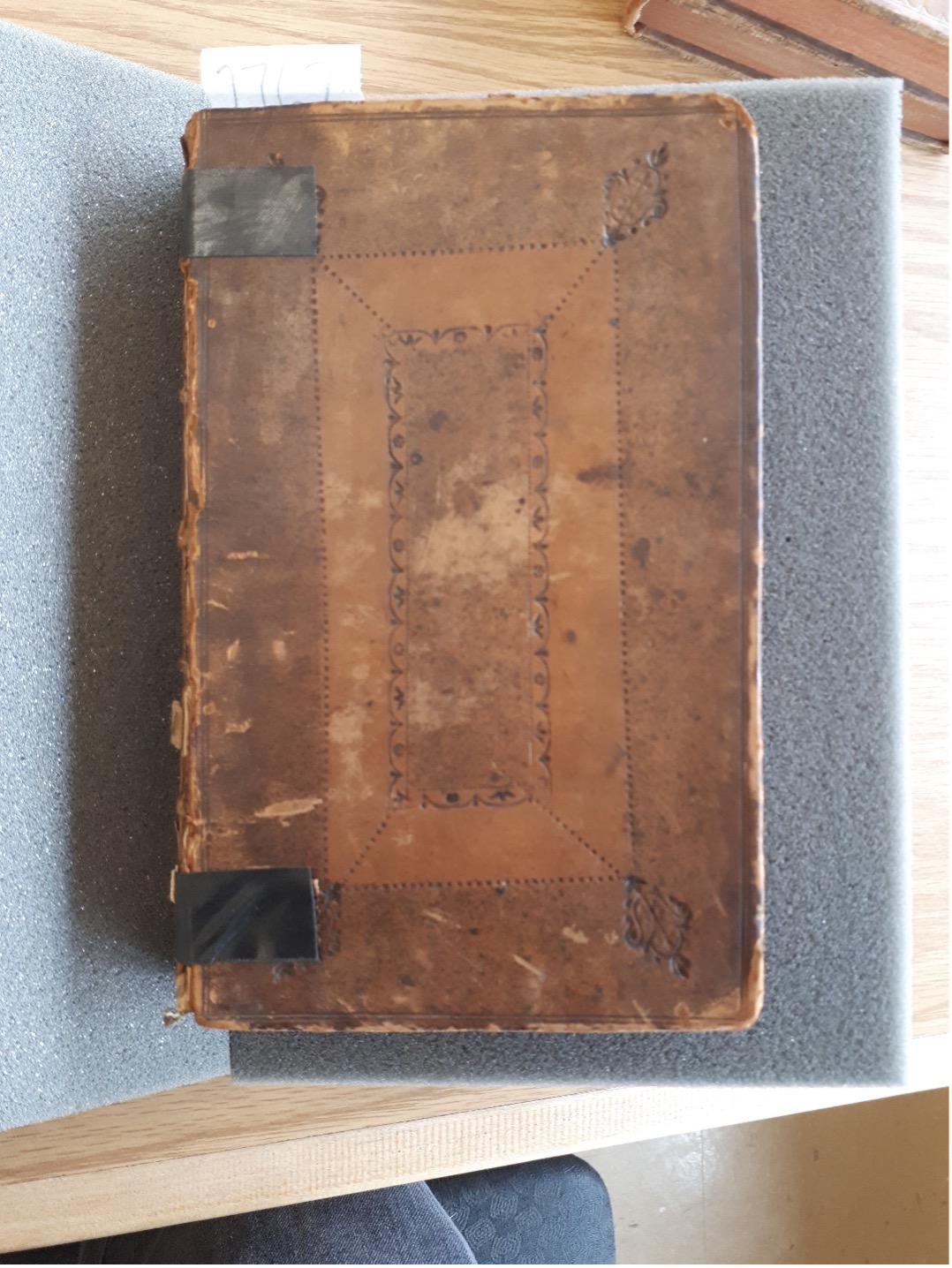
Feild was interested in learning more about the Trinitarian controversy, as evidenced by his owning Bingham’s and Gastrell’s texts. At the heart of both the Trinitarian controversy and Tractarianism was the interpretation of dogma. Even though Bingham sided with Sherlock, this theologian also expressed a desire to protect the church fathers’ stances on dogma. Bingham’s dismissal from academic life indicates that the clergy and university theologians disagreed in this controversy. At the same time, Gastrell’s promotion shows how the clergy believed in the importance of maintaining the standard view that the Trinity was representative of a singular God. Both Bingham’s and Gastrell’s works demonstrate Feild’s upholding of the value of tradition, namely that it was paramount for the Oxford movement to establish the Church of England as the true successor to the apostolic church.