“Is this a revolt?—No, majesty, this is a revolution!” With these words, the Duke of La Rochefoucauld is said to have answered a bewildered Louis XVI, as both watched the growing agitation in Paris, on July 14, 1789. Europe and America had been the scene of many violent uprisings against the yoke of absolutism for some years already—a century and a half in the case of England!—but for a number of reasons, the French Revolution seemed to epitomize the struggle against the abuses of aristocratic privilege. Provoked by famine, blatant poverty, and arbitrary oppression, it rang the death knell of the old order and heralded a new age of individual freedom and social equality.
The church’s role during the French Revolution has often been misconstrued at the expense of a somewhat jaded anti-clericalism. Yet as one of the three orders convoked for the General-Estates of May 1789, alongside nobility and the third estate (or the “commoners”), the clergy is predominantly composed of parish priests upset by the misery of the population and so in favour of drastically improved fiscal equality. Although seriously concerned with the repeated attacks on religion and tradition, a majority of clergymen continued to support the third estate, including when the latter self-proclaimed itself Assemblée nationale in June of the same year, in a famous move toward increased political recognition on the advice of Emmanuel Sieyès, himself an abbot. The French Revolution placed the church in a rather precarious position: if it often supported the disintegration of oppressive political hierarchy, it began to realize this same impetus also threatened its very existence as an institution. Did a similar tension equally haunt Bishop Mullock? He was, after all, a man of the cloth actively committed to social justice in the hope—often disappointed—of reducing the striking inequalities that afflicted Newfoundland in the nineteenth century.
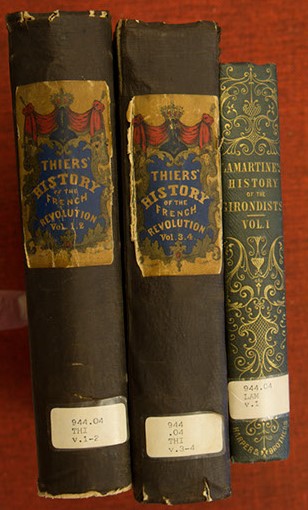
Thiers' The History of the French Revolution, trans. Frederick Shoberl, vols. 1 and 3
Spines of Marie Joseph Louis Adolphe Thiers, The History of the French Revolution, trans. Frederick Shoberl, vols. 1-2 and 3-4 (Philadelphia: Carey and Hart, 1847).
Courtesy of the Basilica Museum - Mullock Library, St. John's, NL.
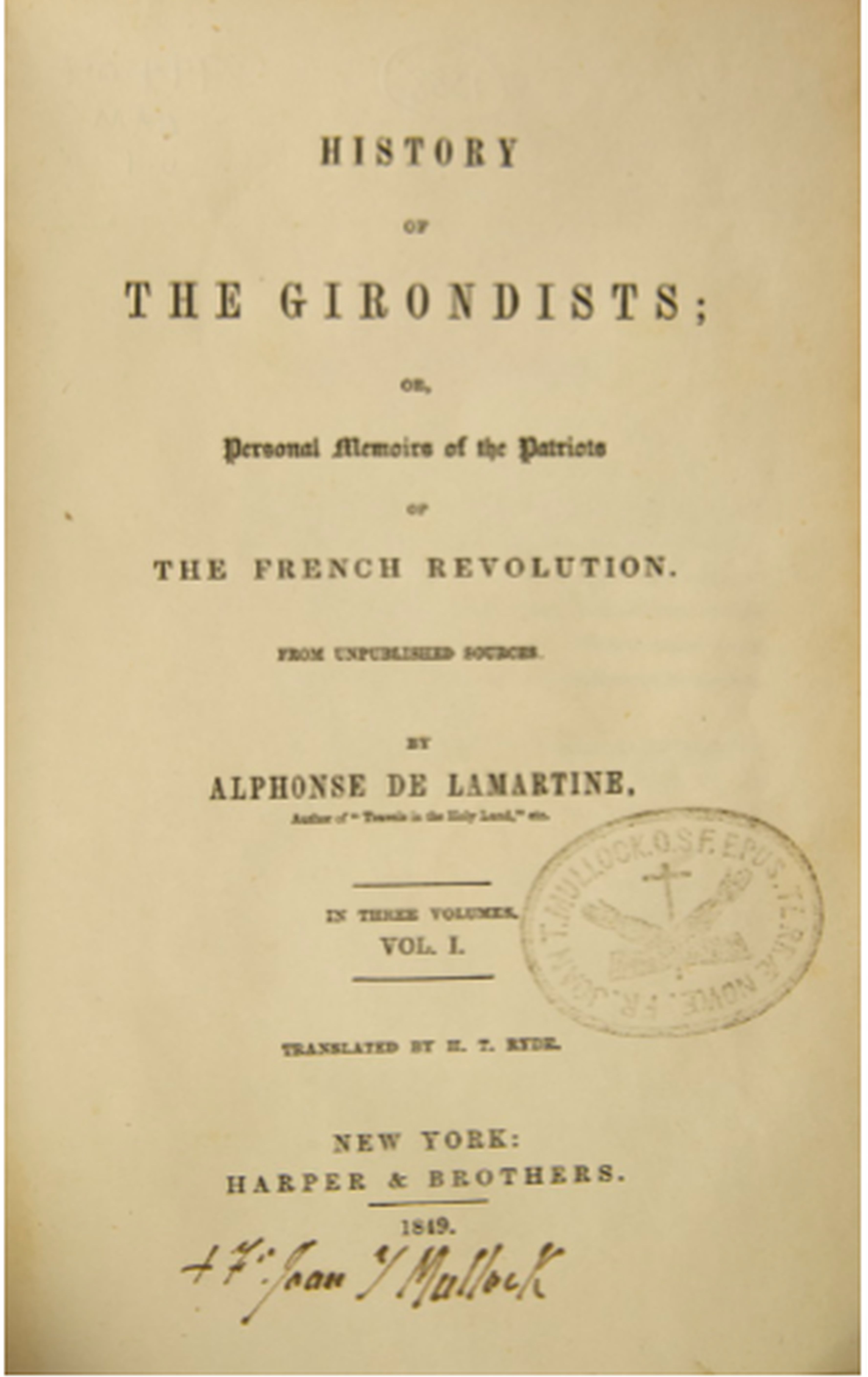
de Lamartine's History of the Girondists; or, Personal Memoirs of the Patriots of the French Revolution, vol. 1.
Frontispiece of Alphonse de Lamartine's History of the Girondists; or, Personal Memoirs of the Patriots of the French Revolution, vol. 1 (New York: Harper & Brothers, 1849).
Courtesy of the Basilica Museum - Mullock Library, St. John's, NL.
This might explain Mullock’s obvious interest in the event, as confirmed by a collection of books on the French Revolution. The first is Adolphe Thiers’s The History of the French Revolution, which Mullock obtained after his consecration as bishop. Journalist, reformist, and one of the most important political figures in France during the mid-nineteenth century, Thiers became the first president of the Third Republic in 1871, following the collapse of the Paris Commune. Accessible and relying on first-hand testimonies, The History of the French Revolution includes ten volumes written between 1823 and 1827, although only the first four are in the Mullock collection. It was the standard work on the French Revolution of Mullock’s time, so much so that, by 1848, it had been republished a staggering twenty times. Hailed by liberals and attacked by conservatives, it is the product of a mind as dedicated to his country as it was to truth.
The History of the Girondists, by Alphonse de Lamartine (1790–1869), is the second of these series. As a poet, Lamartine remains one of the most significant figures of French Romanticism. Interestingly, his father was an officer in Louis XVI’s army, and he defended his king—sword in hand—to the very end. His son, however, remained a Republican at heart, and the History is not only a rehabilitation of the Revolution he claimed had now been conflated with the events of the Terror but it is also a political project meant to revive the democratic ideals of 1789. Published in eight volumes in 1847, it enjoyed tremendous success and inflamed the public by staging the actors of the Revolution—including the moderate Girondins—in such dramatic and compelling fashion that many claim it sparked the popular revolts of 1848, in France. Like many other authors in the Mullock collection, Lamartine is both an advocate of reason and an apologist of religion: the History reflects his efforts to celebrate the one without losing the other. Both historical series were bought when Mullock was already bishop of Newfoundland.