French Neo-classical Drama
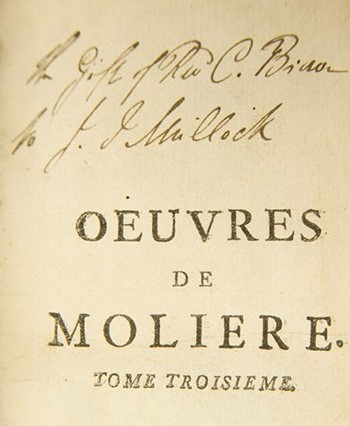
The Mullock collection contains several works of French drama from the seventeenth and eighteenth centuries, including two volumes from the complete works of Molière (1622–73) in an illustrated edition printed in Amsterdam, a gift from Father Charles Browne. Browne inscribed volume 4 at Adam and Eve’s in Dublin in 1838. Mullock was at the convent from 1832 to 1836; he was in Cork for a time before returning there in 1843. Molière was one of the three major French playwrights of the seventeenth century; the other two were Jean Racine and Pierre Corneille.
While Racine and Corneille primarily wrote tragedies, Molière wrote social comedies that drew attention to different forms of hypocrisy. Some of Molière’s works were censored in his day and his name was found on the Index of Prohibited Books. However, his plays are still read and performed today. Tartuffe, Molière’s play on religious hypocrisy, was adapted to nineteenth-century Newfoundland by Andy Jones in 2014.
The French dramatic works in the Mullock collection also include volume 7 of the complete works of Thomas Corneille (1625–1709), the younger and lesser-known dramatist of the two Corneille brothers. This book, also a gift from Father Browne, contains a re-writing in verse of Molière’s prose-play Dom Juan ou le Festin de Pierre along with three original plays. Among the unsigned books in the Mullock collection there is also a 1711 edition of Thomas Corneille’s plays and two 1709 editions of his brother’s (Pierre’s) dramas. There is also a collection of Thomas and Pierre’s plays with extensive commentary published in 1848, probably acquired by Mullock for use at St. Bonaventure’s College.
Volume 3 of Voltaire’s dramatic works is also part of the Mullock collection. Voltaire (1694–1778), primarily known as a philosopher of the Enlightenment period, was a staunch defender of freedom of expression, freedom of religion, and religious tolerance, and he was at times very critical of the Catholic church.
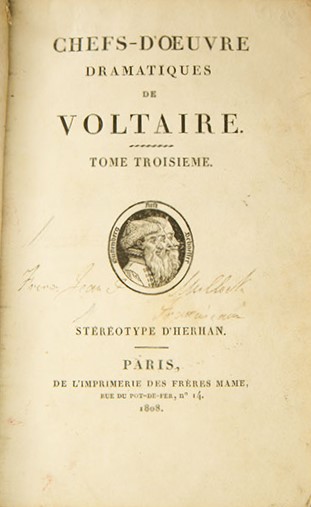
Many of his plays address the same topics as his philosophical writings—along with The Age of Lewis XIV (London, 1752) and volume 7 of The Works of M. de Voltaire (Dublin, 1772) religious fanaticism was treated, for example, in Le fanatisme, ou Mahomet le Prophète. He also composed a comedy-ballet, La Princesse de Navarre, to celebrate the wedding of the Infanta of Spain, to Louis, the Dauphin, son of Louis XV and heir to the throne, the music for which was written by Jean-Philippe Rameau, the most important French composer of the day. Voltaire was the most celebrated French playwright of the eighteenth century, even though his plays are mostly forgotten today. The inclusion of this volume of Voltaire’s plays in the Mullock collection attests perhaps to the importance accorded by Mullock to the dramatic form.
The Mullock collection also contains a volume of the seventeenth-century playwright and novelist Cyrano de Bergerac’s Diverse Works, which includes a series of letters, plus a comedy, Le pédant joué, an adaptation of a Lope de Vega play. De Bergerac (1619–55) was an audacious baroque writer with imaginative and libertine ideas. Today, de Bergerac is better known for the play Cyrano de Bergerac written about him by Edmond Rostand in 1897, decades after Mullock’s death.