Boden and Adams: Feild’s Family Bible
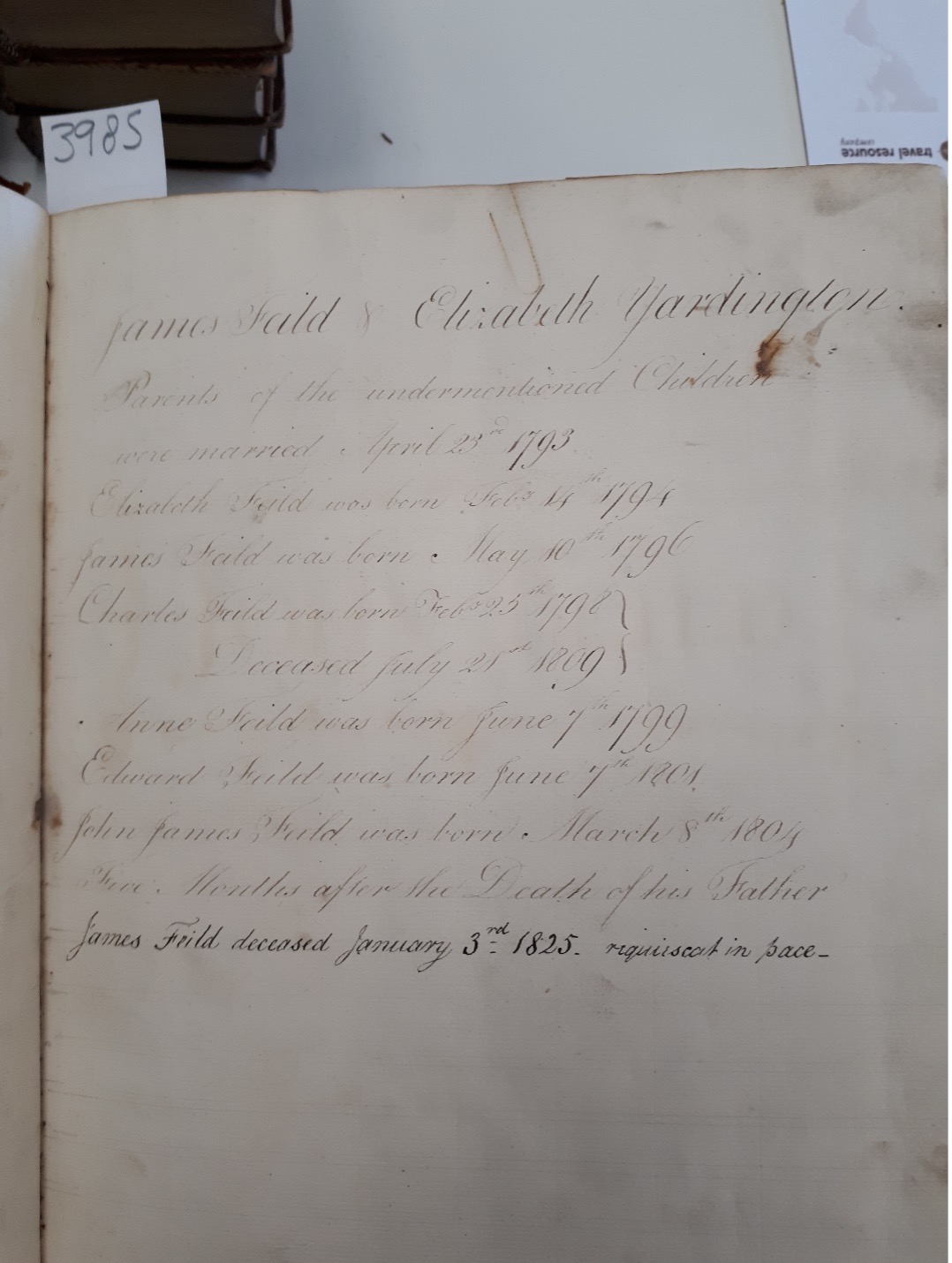
The Boden and Adams’s edition of An Illustration of the Holy Bible Containing the Sacred Texts of the Old and the New; Together with the Apocrypha (Birmingham: Boden and Adams, 1769) is of special interest in Feild’s book collection because it shows his connection to his immediate family. In gold leaf-tooling, the name John Feild is labeled within the inside cover of this Bible. On one of the next corresponding pages is a list of Edward Feild’s siblings and his parents: “James Feild and Elizabeth Yardington married April 23rd 1793, Elizabeth Feild was born Feb. 14th 1794, James Feild was born May 10th 1796, Charles Feild was born Feb. 25th 1798 (Deceased July 21st 1809), Anne Feild was born June 7th 1799, Edward Feild was born June 7th 1801, John James Feild was born March 8th 1804 (Here mourns after the death of his father, James Feild deceased January 3rd 1825).” Most likely this Bible is a family heirloom that had been passed down from James, the father, or Elizabeth, the mother, to John and then later came into Edward’s possession. While there is little information about Bishop Feild’s immediate family in the extant sources, this list highlights his familial connections.
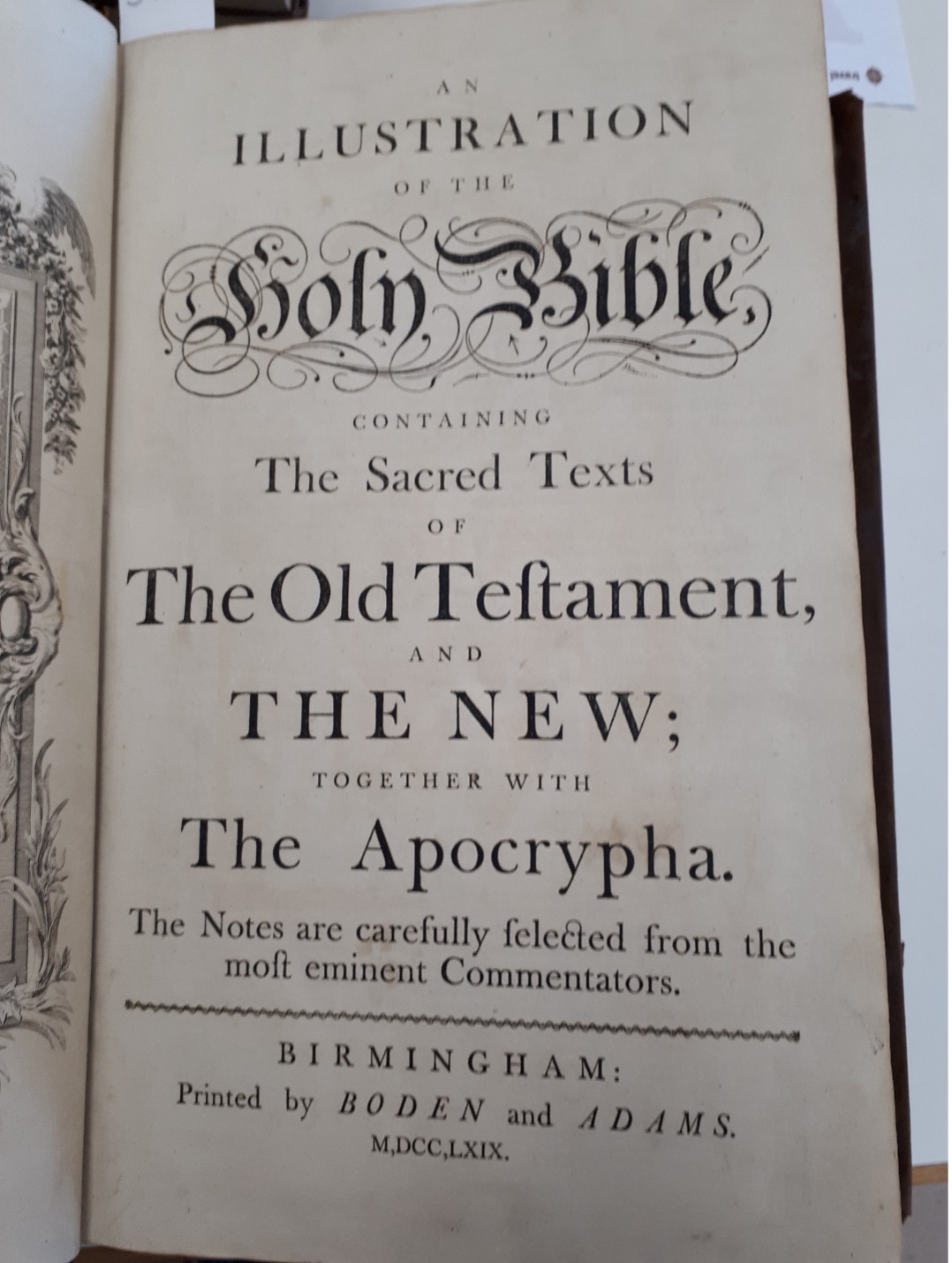
Feild’s ownership of a Bible edited by Boden and Adams interest in past theologians’ advocacy for the Church of England’s primacy as an apostolic institution and defence of its sacred traditions. Little is known about Boden and Adams from the current sources, except that they were English printers in eighteenth-century Birmingham. These editors and printers compiled commentaries on the state of eighteenth-century Christianity. Although the title page in this particular Bible included the declaration that the “Notes are carefully selected from the most eminent Commentators,” printers rarely included these authors’ names. Each theologian chosen by Boden and Adams contends that the Church of England is under threat from skeptics who question the value of religion and the validity of the Scriptures. In “An Introduction to the Old Testament,” the commentator argues that a “bolder spirit of Infidelity than usual, has of late gone out into the World; teaching some to look upon Religion as a mere Trick” (1). The commentator makes a direct reference to the Age of Enlightenment, when people used scientific methods and rationalism to question what they believed to be the superstitious nature of religion. The commentator criticizes rationalism by stating that the truth of the Scriptures cannot be questioned because people require divine assistance in order to fully understand them and that skeptics have disregarded God’s authority by inferring that humans wrote these sacred texts.
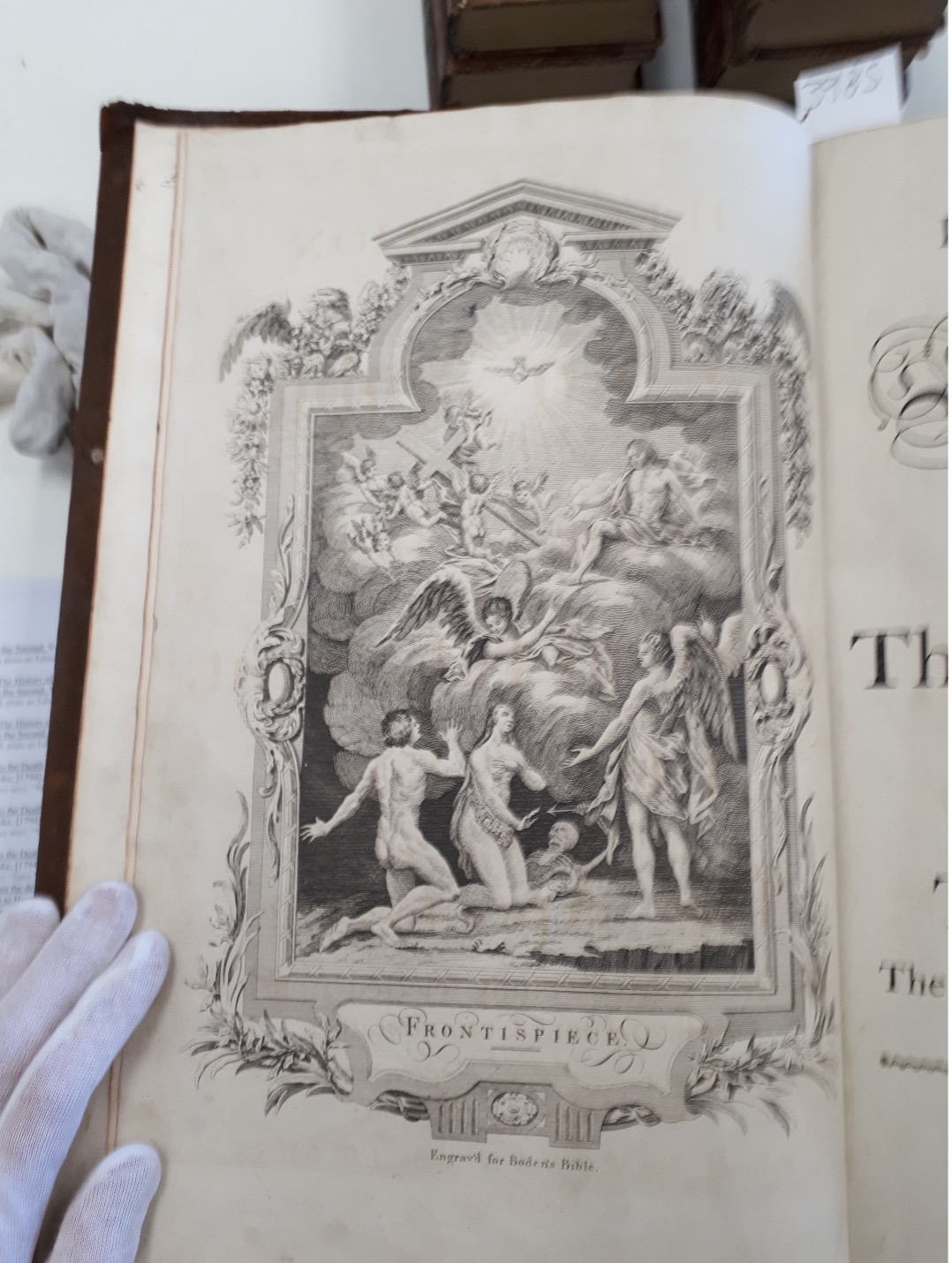
In particular, one commentator discusses the importance of revelation through which God is “making known, which was secret” (i) to his followers and extrapolated from this that Adam required divine aid to understand the world around him. Consequently, knowledge is not obtained through learning, as Enlightenment thinkers maintained, but passed down from God to humans. Boden and Adam emphasize the importance of this thinking by placing an engraving of Adam’s and Eve’s fall on the frontispiece. The introduction, written by another commentator, which Boden and Adam included to the Old Testament examines how Moses and other prophets prove the existence of revelation by positing that similar truths could have come only come through divine inspiration. As the prophets were born in different places and time periods, the only explanation for their similar prophecies was that God had delivered them as revelations. As such, the commentator states, the “promulgation of the Law on Mount Sinai, was one of the most amazing things that ever happened ... all imaginable advantages in favour of Tradition” (iii). What makes the Old and New Testaments significant is that they relay God’s traditions to worshippers.
Boden and Adams’s inclusion of commentators who argued against skeptics indicates that these printers were concerned with the Enlightenment’s growth of secular thinking and criticism of Christianity. The commentators’ concern with rationalism is similar to Feild’s own apprehension against Christian sects, such as Evangelicals and Wesleyans, who criticized his Tractarian approach to Anglicanism in Newfoundland. For Feild, much like for Boden and Adams, the traditions of the Scriptures were unquestionable and their application of faith should be uniform for everyone.