Eighteenth-Century English Poetry
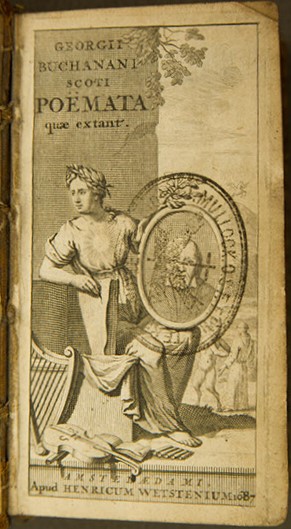
The Mullock collection contains an assortment of sixteenth-century neo-Latin and eighteenth-century English poetry. One early exponent was George Buchanan (1506–82), who tutored a son of James V, Mary Queen of Scots, and James VI. A one-time prisoner of the Inquisition, he later supported the deposition of Mary as well as the Protestant Reformation in Scotland, so Buchanan would not have been high on a Roman Catholic bishop’s reading list. However, he translated Medea and Alcestis, both plays by Euripides, which are included in Mullock’s volume of Georgii Buchanani Scoti poëmata, which features an engraved title page with an Amsterdam imprint “Apud HENRICUM WETSTENIOS, 1687,” presumably the forebear of the printer of Mullock’s copy of Richard Bentley’s edition of Horace. Mullock’s oval library stamp is evenly applied around a medallion portrait of Buchanan in the lap of a muse but obscures details. The name of Paul Benson, apparently an earlier owner, is written at the top of the biographical introduction.
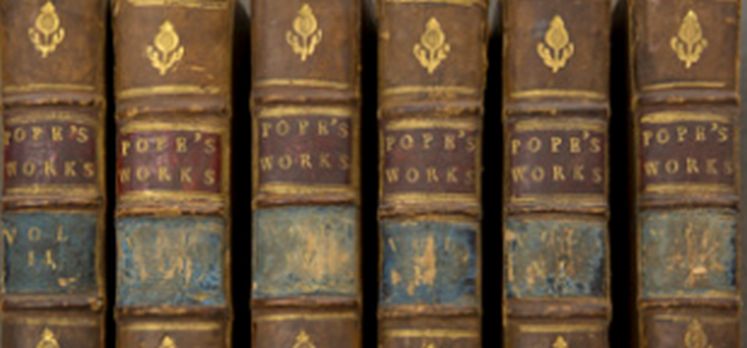
Mullock had an odd volume of Alexander Pope’s Epistles and Satires, volume 2 reprinted in Dublin by George Faulkner, A. Bradley, and T. Moore in 1740. Published within Pope’s lifetime, it contained his Essay on Man, which had originally appeared in four epistles seven years earlier. Mullock also had a broken set of a 1770 edition of Pope’s Works: six out of eight volumes. Missing are volumes 1 (containing masterpieces like “An Essay on Criticism” and “The Rape of the Lock”) and 7 (containing the latter part of the poet’s letters). Pope’s works were massively popular throughout the eighteenth century. Within ten years of his death in 1744, more than 100,000 volumes of his works were printed; 1770 alone saw seven editions: three from Dublin, three from London, and this one, in duodecimo, published by Martin & Wotherspoon of Edinburgh. The title page to the missing first Pope volume reads: “with his last Corrections, Additions, and Improvements. Together with all his Notes.” What is missing from the title page is the name of William Warburton, Pope’s designated literary executor and editor. To have named him, no doubt, would have invited trouble. While sometimes illicit, Edinburgh editions were prized for their textual accuracy and they generally cost less than their bona fide London counterparts.
Mullock had a two-volume set of James Thomson (1700–1748). This edition is dated 1768, an important year in the history of this work and in the history of publishing. Thomson’s Seasons was at the centre of an important copyright case. The case of Millar v. Taylor was argued in the court of King’s Bench in London. Andrew Millar, like Thomson, was born in Scotland, but moved to London to make his fortune. According to the term-limit of the Copyright Act of 1710, Thomson’s Seasons should have become public domain by 1762 at the latest—fourteen years after Thomson’s death. Millar discovered that Robert Taylor, a printer-bookseller in Berwick on Tweed at the border between England and Scotland, published an edition of Thomson’s Seasons for local consumption. The judge, Lord Mansfield, found for the defendant, giving perpetual monopoly legal standing.
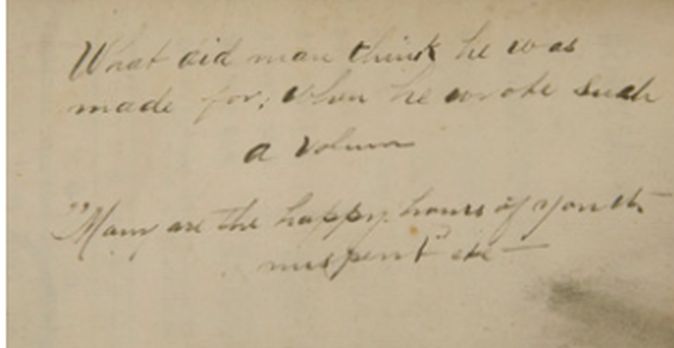
Mullock’s copy bears the imprint “printed for J. Thomson,” suggesting that the author was self-publishing. Unfortunately, Thomson had been dead for twenty years. In other words, Mullock had acquired a pirated edition, although “pirated” is a debatable designation: what may have been illegal one year was not necessarily so in another. The second volume has a note on the front endpaper. The title page bears three stamps, one of which almost obscures the date of publication, and the name of William Digby. On the rear endpaper is written in ink: “What did man think he was | made for, when he wrote such | a volume. | “Many are the happy hours of a youth mis[s]pent” etc.” The Mullock collection also contains a copy of Trifles (1745), a collection of works by Pope’s protégé, publisher and poet Robert Dodsley.