The Church Fathers: Augustine
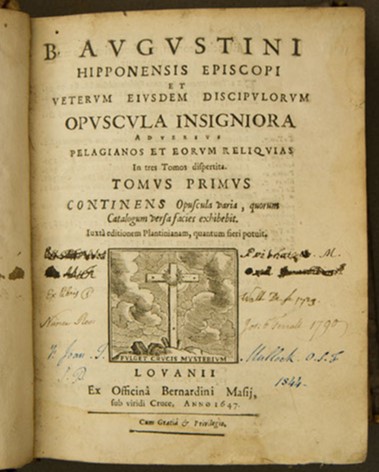
The Mullock collection contains three works by Augustine (354–430 c.e.), one of the great doctors of the church, whose enormous influence on the history of Western theology cannot be overestimated. “What is more august than Augustine?” asks the editor in the preface to volume 1 of a 1647 Latin collection of Augustine’s “anti-Pelagian” works (Opvscvla insigniora adversvs Pelagianos et eorvm Reliqvias) in the collection. This volume, the first of three, contains several of Augustine’s anti-Pelagian writings, which address the Pelagian controversy over theological positions concerning the meanings of human freedom and divine grace, the transmission of sins, and the function of infant baptism, among others. Only the first volume is in the collection. While one might expect to find Augustine represented in the library of a Catholic bishop or anyone interested in Western theology and philosophy, this volume in particular might have found its way into there as a result of Mullock’s translation of Ligouri’s The History of Heresies, of which Mullock wrote, “there is no Heresy which cannot be refuted from it” (vii). The fifth chapter of the The History of Heresies contains an article devoted to the “Heresy of Pelagius,” which, appropriately, given his prominent role during the controversy, abounds with references to Augustine. Mullock’s inscription appears on the title page among those of the book’s previous owners, indicating that he obtained this volume of Augustine’s works in 1844, three years before the publication of his translation of Ligouri’s The History of Heresies.
In the collection, as one might expect, is an edition of Augustine’s Confessions, which, along with his De Trinitate and De civitate Dei, comprise the Doctor of Grace’s major and most famous works. An instant classic since the time of its completion in 401 c.e., the Confessions has ever since enjoyed a widespread and enthusiastic readership. In short, it is a masterpiece of theology, philosophy, and literature, in addition to being one of the earliest examples in Western literature of autobiography and deep, personal, psychological reflection. This 1770 edition, translated into English from Latin, contains only the first ten, and more explicitly autobiographical, of the thirteen books of the text. The eleventh, on time and eternity, and the books on creation and the author’s interpretation of the beginning of the book of Genesis are omitted; the anonymous translator’s preface provides the reason: “Because the Contents of them are for the most Part so hard and obscure, that they would be of small Edification to those for whose Benefit this Translation is chiefly designed” (A2v). Arguably the greatest spiritual classic in Western literature, it is no surprise to find a copy of Augustine’s Confessions among Mullock’s volumes. No further information can be gleaned from the book’s inscription, which contains only the name of its owner: Fr. J. T. Mullock - OSF.
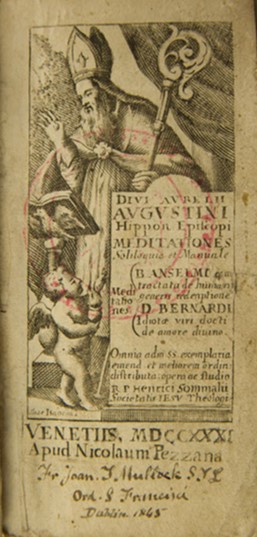
Finally, the collection also contains a little volume entited Meditationes, Soliloquia et Manuale (Meditations, soliloquies, and manual), containing, in addition to the Augustinian writings, meditative selections of Saints Anselm and Bernard of Clairvaux. The “Augustinian” works contained within the volume, however, were not written by Augustine at all, but were composed and circulated under the aegis of his name. Despite the pseudonymous authorship, the work nevertheless mimics Augustine’s style and thought in meticulous detail—an impressive accomplishment in its own right. The apocryphal texts, collected together as Augustine’s Meditationes, were widely popular and saw many printings in Latin and various vernacular languages since the mid-sixteenth century.
The volume contains short devotions and meditations organized around themes, wherein the meditator speaks to himself or herself and to God in the manner of a soliloquy (a term coined by Augustine), which one observes perfected and mastered in Augustine’s Confessions. Befitting its purpose, the book itself is small and meant to be carried on one’s person. According to the inscription, Mullock obtained the book in Dublin in 1845, during his tenure as guardian of the Franciscan convent of Adam and Eve, before being sent to St. John’s, Newfoundland.