The Spanish Golden Age: Cervantes and Quevedo
Only a few books remain from Bishop Mullock's extensive collection of Spanish books which he started to gather during his studies in Seville, Spain. These include two prominent writers: Miguel de Cervantes (1547–1616) and Francisco Gómez de Quevedo y Santibáñez Villegas (1580–1645). Mullock acquired a copy of the second part (Parte secunda) of Cervantes's Don Quixote, but due to the lack of a title page, it is hard to identify the exact edition; it was most likely printed between 1615 and 1617. Mullock acquired a copy of the fourth edition of Tobias G. Smollett's (1721–1771) English translation, dated 1770 and printed in London. It was published for William Strahan, one of Smollett's partners who owned shares in the English editions of Don Quixote. Strahan (1715–85) placed his name first on the long list of printers. Smollett's first English version of Cervantes's masterpiece was published in London in 1755. Smollett, a doctor by profession, was not the first to attempt to fully translate Cervantes's novel, yet it is one of the most influential among English readers. Mary Wagoner's list of Smollett's work (1984) includes more than 30 of his editions. One of Smollett's latest versions was re-edited in 1986 by Carlos Fuentes, the well-known Mexican writer, who declared it the “authentic vernacular version.”
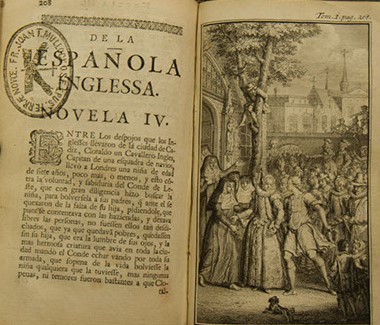
While in Spain Mullock also obtained two copies of Cervantes's Novelas exemplares (Exemplary novels), written between 1590 and 1612. The first edition was printed in Madrid in the well-known publishing house of Juan de la Cuesta. These novellas of Italian inspiration gather a mixed series of twelve idealistic and realistic tales, which include, among other stories, Rinconete y Cortadillo, El Licenciado Vidriera (The lawyer of glass), La Española Inglesa (The Spanish English lady), and La gitanilla (The little gypsy girl). This particular volume in the Mullock collection of the Novelas exemplares is, according to the title page, a new corrected text published with the required licence and approbation in Valencia in 1797 in the publishing house of Salvador Fauli (or Pauli). It was dedicated to Don Pedro Fernández de Castro de Lémos, de Andrade y de Villalba (1576–1622), vice-president of the Council of the Indies and Viceroy of Naples. The second copy of Cervantes's Novelas exemplares in the Mullock collection was printed in The Hague in the publishing house of J. Neaulme in 1739 and dedicated by its editor, Pedro de Pineda, a teacher of Spanish and resident of London, to the Countess of Westmorland. Both volumes in the collection are decorated with twelve copper plates.
An eighteenth-century imprint of the famed poet Quevedo also survives in the Mullock collection. According to Mullock's inscription on the title page, he acquired it in 1838 in Ireland. The first texts of Quevedo's poetry appeared in 1605 in his anthology Primera parte de las flores de poetas ilustres de España. ost of his poems, however, were included in his Parnaso español (Spanish Parnassus) and his Tres musas castellanas últimas castellanas (The last three Castilian muses) published posthumously in 1648. These two works include 875 poems, mostly of a satirical nature divided into nine categories. This particular edition was printed in Madrid by the well-known publishing house of De Sancha in 1794. This edition is part 8 of Quevedo's complete works in the De Sancha authoritative edition. It is of some interest since its editor included a number of prohibited poems which were deemed offensive. This particular anthology of 875 poems was included in the inquisitorial indexes of 1707 and 1790; it includes the required licence and approval from the censors.