The Bollandist Enterprise
The Acta Sanctorum is a multi-volume critical edition in folio volumes of the “lives” and “acts” of the Christian saints, based on a critical examination of the manuscripts, and arranged in order of the calendar year. The idea for such a collective work was that of Heribert Rosweyde (1569–1623), a Belgian Jesuit, but he did not live to see any of the published volumes. Under the guidance of Jean Bolland (1596–1665), another Belgian Jesuit, and his successors, the work continued. They founded a society in Brussels (la Société des Bollandistes), which between 1643 and 1794 published the volumes for January through October 14 (the last three by former Jesuits). The Belgian Jesuit order was suppressed in 1773, but the work was resumed by the Société des Bollandistes in 1837. The collection was not finished, but by 1925 editing had reached November 10; the Propylaeum (“introduction”) to the saints of December was published in 1940. Since 1822 the Société des Bollandistes has also published a quarterly journal, Analecta Bollandiana, devoted to the study of saints and the publication of unpublished documents associated with the lives of saints.
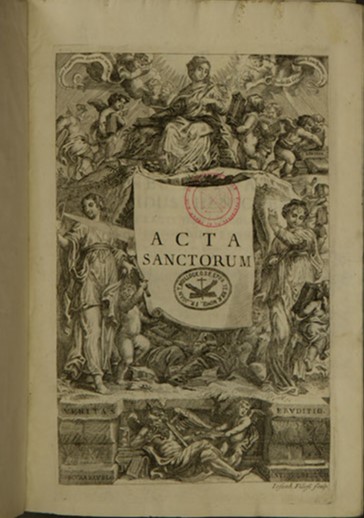
There are three “versions” of the Acta Sanctorum: the original series, published in Antwerp between 1643 and 1940; a Venetian edition consisting of the first 50 volumes, published between 1734 and 1770; and a Parisian edition, published in 60 volumes between 1863 and 1867, with a general index in 1875. The Société des Bollandistes continues work on the collective edition. The Mullock collection contains the Venetian edition. The Acta Sanctorum is especially valuable because of its inclusiveness and the scope of its entries. The editors attempted to include all surviving lives of the saints, with the result that many of the more important or more widely venerated saints often have multiple lives by multiple authors. Although the lives are almost entirely in Latin, they form an indispensable basis for studying the lives of the saints and assessing their historical and religious importance for Western Christianity. Mullock appears to have purchased this edition in 1850, judging from the presence of his signature and date on the title page of volume 1. Mullock used the folio volumes of Acta Sanctorum as a sort of archive, pasting many of his pastoral letters and local newspaper articles into the various volumes, forming a repository of personal and public documents.