Pierre Bayle’s Dictionnaire historique et critique
Pierre Bayle (1647–1706) was a Calvinist thinker. Briefly a convert to Catholicism, he began and ended his life as a member of the reformed church. Bayle’s project in writing his Dictionnaire historique et critique was to correct the mistakes found in the dictionaries and reference materials already available. For Bayle, no mistake is too small to be corrected and thorough verification can only serve the common good. His method of comparison and fact checking reveals divergences among authorities, relativizes knowledge, and leads to a defence of diversity and tolerance. He sought as much to calm the excessive fervour of Calvinists like Pierre Jurieu as the exaggerated claims of Catholics like Louis Moreri. Through a series of essays and preliminary publications, Bayle benefitted from the comments and suggestions of many collaborators and happily corrected himself in subsequent editions. Mullock’s copy of volume 1 (A–D), for instance, contains two articles on King David, one integrated in the alphabetical sequence and a second, longer, article appended at the end of the volume.
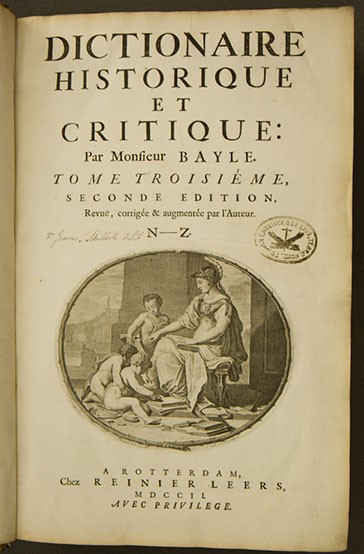
Bayle’s dictionary demonstrates erudition of rare scope and his use of notes, references, multiple typefaces, and quotations in several languages becomes more complex with each edition and was probably not surpassed until the age of digital retrieval systems. The dictionary offers articles on a wide variety of contemporary, biblical, and mythological personages. In his dedication to separate legend from fact, Bayle was among the first to apply the historical method to biblical scholarship. His article on King David is irreverent, his life of Eve provocative, and his entry on the Prophet Mohammed was plagiarized at length by Voltaire himself. The Dictionnaire found its way into the libraries of clerics of all stripes; such was the breadth of its erudition and the wealth of references it contained that all were sure to find arguments and facts to support their points of view.
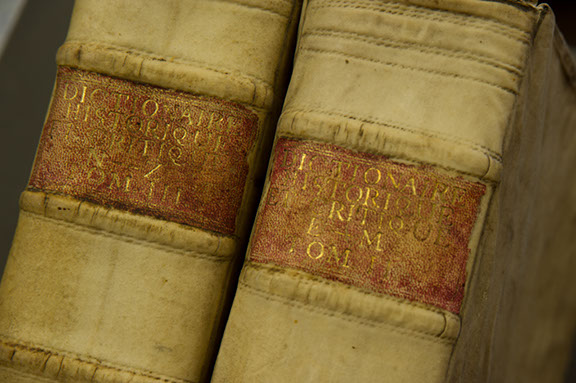
Mullock’s copy is the second edition (1702) in three volumes. Besides the worn limp binding, which is detaching from the pasteboard, the volumes are in good condition. Each volume bears Mullock’s name inscribed on the title page or first page (volume 2 has no title page).
Bayle’s Dictionnaire historique et critique states that David Ancillon (1617–92) was born in Metz, France. Though he received his early education from Jesuits, Ancillon remained true to the reformed church and went on to study theology in Geneva. He fled to Frankfurt upon the revocation of the Edict of Nantes and after a stint at the French church in Hessen (Germany), returned to Frankfurt, and then went on to Berlin, where he died. Throughout his life he was known and respected by clergymen of both theological persuasions for his knowledge, eloquence, and virtue. As Bayle includes Ancillon in his Dictionnaire, so Ancillon mentions Bayle’s Dictionnaire in his preface.
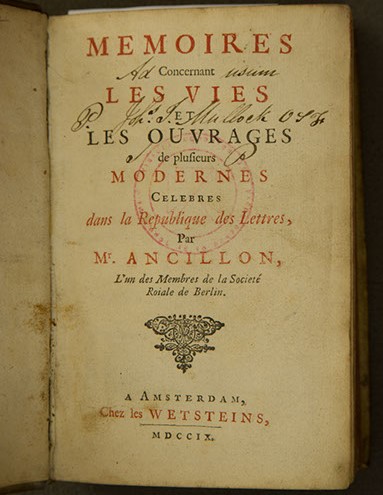
Ancillon enumerates several existing catalogues and dictionaries of notable persons already in existence but notes that there are always names that have been left out. His project is to offer personal reminiscences of so-far-uncatalogued notables. Though Ancillon is from a Calvinist family, his Mémoires concernant les vies et les ouvrages de plusiers modernes celebres dans le Republique des Letters (Reminiscences concerning the lives and works of several famous moderns in the republic of letters) includes writers and clergymen of both the Catholic and Calvinist persuasions. None of the notables he catalogues are household names today. Mullock’s copy of Ancillon’s Mémoires is a pocket-sized edition printed in Amsterdam in 1709. It is identified by Mullock’s name written on the title page in flowing cursive and has slight water damage and a stained cover.