George Bancroft and the Rise of American Historiography
As Bishop Mullock’s many interests included politics and history, it is not surprising to find volume 1 of George Bancroft’s History of the United States, from the Discovery of the American Continent (London, 1855), which he signed and dated in 1857. Bancroft was an immensely popular historian in nineteenth-century America. A Unitarian with a degree from Harvard, he travelled to Europe, where he learned the most up-to-date German historiographical practices. A man of tremendous intellect and patriotism, Bancroft believed in providence and progress and his account was comforting to many nineteenth-century American readers.
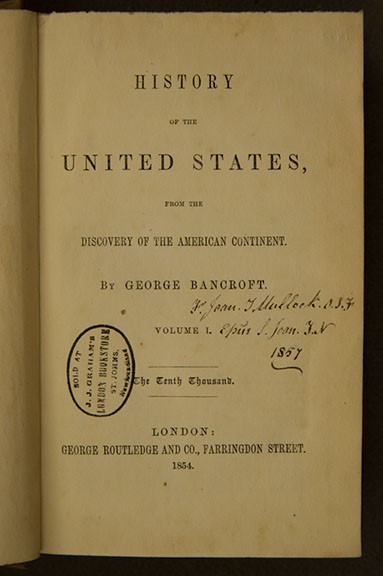
Bancroft was widely considered to be the first American historian to use primary sources to write a comprehensive history from the origins of European settlement to the United States of his day. His faith in progress was bolstered by his idea of Protestantism and his belief that the United States embodied the pinnacle of social and political structures. As History of the United States was primarily a political and military historical narrative, it contained only incidental references to Newfoundland. Bancroft had little to say about social or economic forces, so the northern colony that did not join in the American Revolution was of little importance.
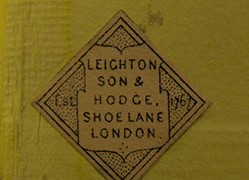
Mullock’s copy of Bancroft’s History has a stamp of “J.J. Graham’s London Bookstore, Saint Johns, Newfoundland,” which is the only indication of a book purchased in St. John’s in his library. Little is known of the bookseller James Joseph Graham, who opened his London Bookstore in 1847. Another stamp on the rear pastedown denotes “Leighton Son and Hodge. Shoe Lane, London.” Archibald Leighton had invented cloth binding, and his firm passed to his son Robert Leighton upon his death in 1841. Robert Leighton was also a pioneer in the book-binding business, inventing a method for using coloured inks in cloth bindings. His partner and cousin John Leighton was renowned for his creativity in designing book covers.
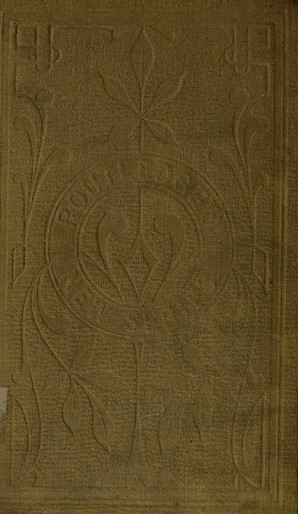
The first edition of this ten-volume work was published in Boston in 1834, and multiple editions were printed over subsequent decades. The edition in Mullock’s library was first published in London in 1851 by Routledge, a firm started by George Routledge (1812–88) in 1843. It specialized in cheap reprints and was among the first to produce cheap editions of American authors unprotected by European copyright laws. Combining Leighton’s innovative technique of cloth binding, which made book production far cheaper, and Routledge’s policy of popularizing unprotected American writers, this edition of Bancroft’s History is an interesting early example of the rapidly commercializing book trade in the nineteenth century.