Queen's College Collection
The Queen's College Collection originally catered to the Anglican Theological Institute and Collegiate School for Boys, established respectively by Bishop Spencer in 1841 and by Bishop Feild in 1844. Following the formation of the diocese of Newfoundland in 1839, the first bishop, Aubrey George Spencer (1795-1872), founded the Anglican Theological Institute with the intention of training local clergymen. Although some of the first students were brought from England, the institution quickly attracted young Newfoundlanders as well. During Bishop Spencer’s four-year tenure, the clergy grew from 8 to 25 members. Upon his departure to become Bishop of Jamaica in 1843, Spencer famously claimed that his successor would need “the strength of constitution to support him under a climate as rigorous as that of Iceland” (Encyclopedia of NF vol 2 29). When his replacement Edward Feild (1801-1876) arrived in St. John’s during the summer of 1844, he succeeded Spencer as bishop of Newfoundland and Bermuda (495). Born in Worcester, England, Feild was educated as a mathematician at Queen’s College, Oxford and had unsuccessfully pursued a fellowship position at Oriel College before entering the Church of England priesthood. At the same time, Feild also gained a reputation as a pioneering educationalist. As the archival records reveal, as soon as he arrived in St. John's, he founded a school in a hired house and furnished it with books and furniture at his own expense. Feild opened The Collegiate School for Boys, which would later become Bishop Feild College, appointing the Master’s degree holder Reverend C.W. Newman as its first head deacon (495). While the Theological Institute and Collegiate School’s stock of literature initially consisted of his personal book collection, Feild made concerted efforts to augment it with volumes purchased with the help of a fund set up by the Provost and Fellows of Queen's College, Oxford, and donated by Feild's other supporters in England. As Feild worked to expand the theological seminary, the Institute was re-founded in 1847 under its new title, Queen’s College, in honour of Queen Victoria and Feild’s Oxford alma mater (495).
The Queen's College Collection catered to the Anglican Theological Institute and Collegiate School for Boys, established respectively in 1841 and 1844. The Theological Institute was re-founded as Queen's College by the bishop of Newfoundland and Bermuda, Edward Feild in 1847, while the Collegiate School for Boys would come to be known as Bishop Feild's College. Similar to the Mullock Library, Edward Feild's private books form the nucleus of the Queen's College Collection. Prior to his arrival in Newfoundland, Feild gained a considerable reputation in England as a pioneering educationalist, and subsequently made concerted efforts to stock the library of Queen's College from the onset of his ministry. Indeed, as the archival records reveal, as soon as he arrived in St. John's, he founded a school in a hired house and furnished it with books and furniture at his own expense. Although a dedicated library building would not be erected until Reverend William Pilot, vice-principal of Queen's College, raised a further sum to extend the existing buildings of the college in 1876 (the year of Feild's death), a substantial part of the collection must have been assembled by then.
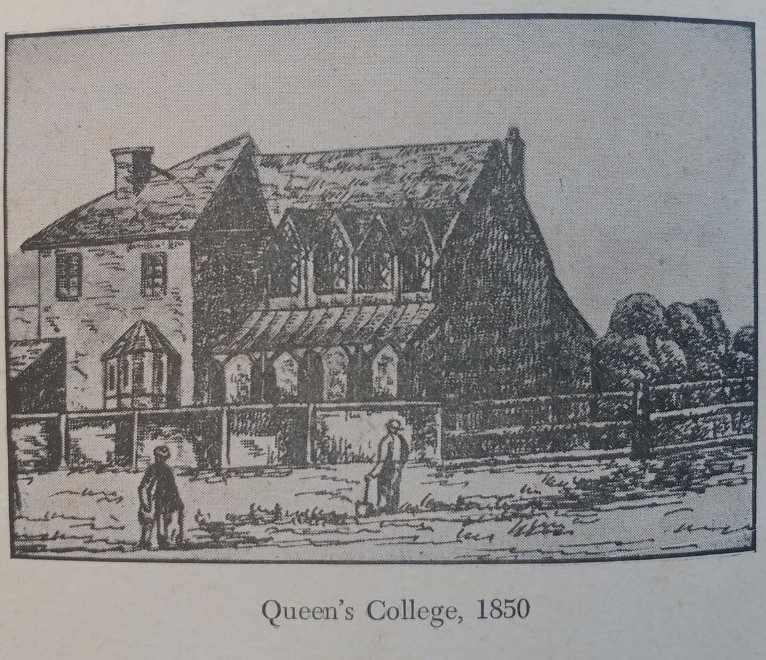
Although a dedicated library building would not be erected until Reverend William Pilot, vice-principal of Queen's College, raised a further sum to extend the existing buildings of the college in 1876 (the year of Feild's death), a substantial part of the collection must have been assembled by then. The majority of the classical volumes at Queen’s College comprise Latin and Greek editions published in the early nineteenth century. These classical texts include full sets of texts required for the Latin curriculum, primarily consisting of critical editions published in London by well-known printer Abraham John Valpy, which include reissued versions of the famous Delphin Classics of the 1670s, such as the complete works of Boethius, Caesar, and Virgil, all newly edited by English poet, George Dyer.